
 Available in US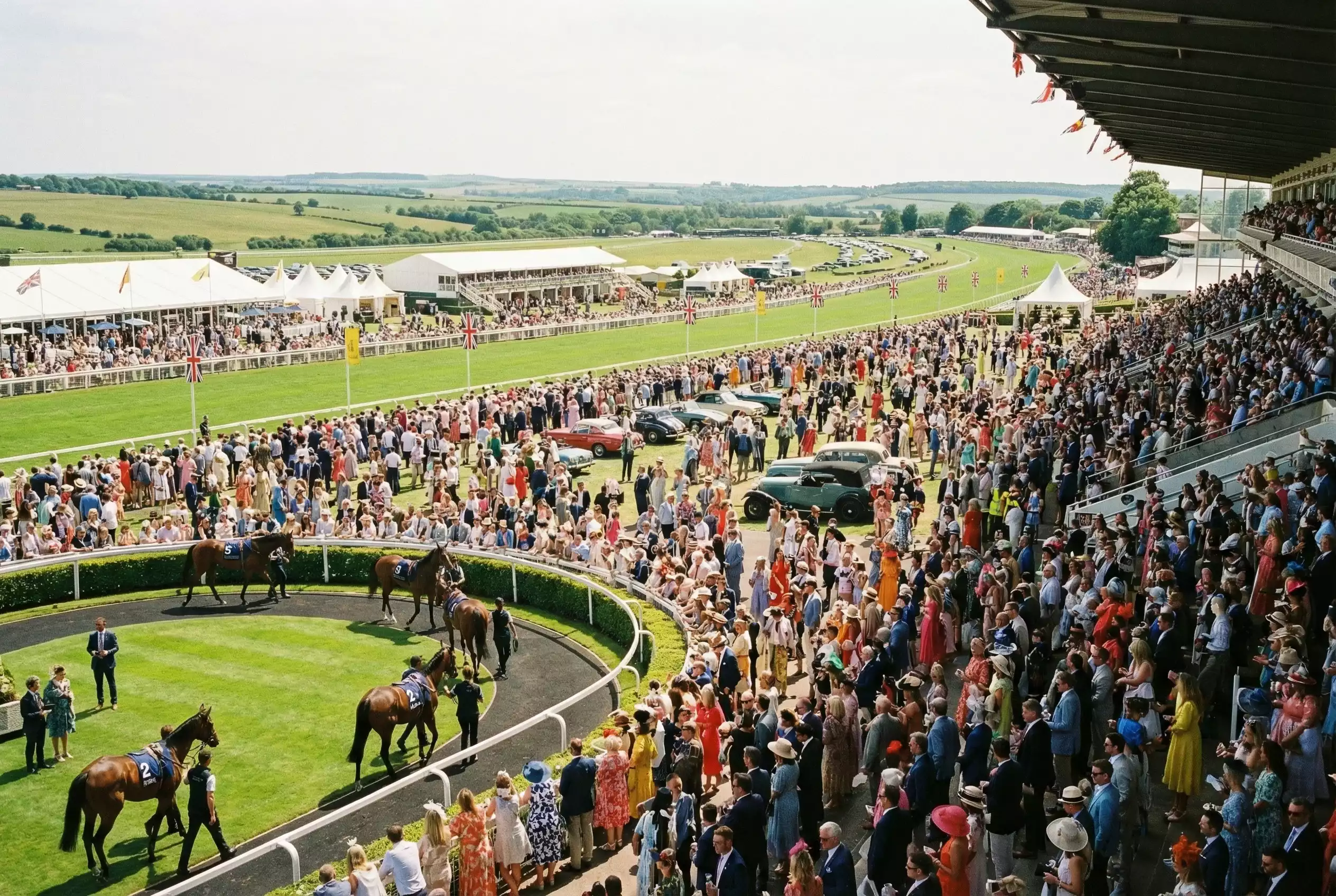
Plan Your Five Days on the Downs
A glorious Goodwood day by day guide is less a luxury than a necessity if you want to navigate the festival with any kind of strategy. The Qatar Goodwood Festival packs 37 races across five days, including 16 Group contests and three at Group 1 level. Each day has a distinct character, a different headliner, and a different betting profile. Treating the festival as a single block is the quickest way to blow your budget by Wednesday afternoon.
The five days run from Tuesday to Saturday in late July, and the shape of the week follows a deliberate arc. Tuesday eases you in with competitive handicaps and lower-tier Pattern races. Wednesday and Thursday deliver the heavyweight Group 1 action. Friday mixes sprint speed with middle-distance class. Saturday sends everyone home with the biggest-field handicap of the meeting and a carnival atmosphere that feels nothing like the serious racing earlier in the week. Understanding that arc helps you allocate your time, attention, and bankroll where they will do the most good.
Glorious Goodwood Day-by-Day Schedule & Highlights — More on this topic at goodwood betting.
Tuesday — Opening Day
Tuesday sets the tone without overwhelming you. The card typically features seven races, led by a couple of Group 2 or Group 3 contests and supported by heritage handicaps that draw large, competitive fields. It is the quietest day of the festival in terms of crowd size, which makes it the most comfortable day to attend if you prefer to study the form in peace rather than jostle for a view of the parade ring.
From a betting perspective, Tuesday is a day for selective engagement. The handicaps often produce sizeable fields — twelve to eighteen runners — which means each-way value is available if you can identify a horse whose form fits Goodwood’s specific demands. The Pattern races are useful less for betting and more for intelligence: they reveal early clues about the ground, the pace bias, and whether the track is riding as expected. Watching how Tuesday’s races unfold gives you practical information that will sharpen your bets for the rest of the week.
Opening day is also the day when the track’s going report becomes real rather than theoretical. Whatever the clerk of the course has been saying all week, Tuesday’s first race shows you how the ground is actually riding. Pay attention to the margins, the finishing speeds, and how horses with different running styles perform. That data is free and it is invaluable.
Wednesday — Sussex Stakes Day
Wednesday is the first marquee day, built around the Sussex Stakes — the only Group 1 mile race in the mid-summer calendar and the centrepiece of the first half of the festival. The atmosphere steps up noticeably from Tuesday, with larger crowds and sharper market activity from the moment the betting ring opens.
The Sussex dominates the day’s narrative, but the supporting card is strong in its own right. Wednesday usually includes competitive handicaps over a variety of distances, giving punters plenty of opportunities beyond the big race. The practical approach is to allocate a significant portion of your Wednesday budget to the Sussex if you have a strong view, and use the handicaps for smaller, value-driven bets where the each-way terms offer a safety net.
Wednesday is also the day when the festival’s true pace character reveals itself. By the time the Sussex goes off in the afternoon, you have already seen three or four races on the same ground. Use that information ruthlessly. If the early races suggest that front-runners are dominating, adjust your Sussex selection accordingly. If closers are finishing strongly, the Sussex is likely to be a patient, tactical affair.
Thursday — Goodwood Cup Day
Thursday belongs to the stayers. The Goodwood Cup, a Group 1 over two miles, is the day’s headline act and one of the most prestigious staying races in the European calendar. The card also features quality middle-distance contests, making Thursday the day for punters who appreciate stamina, tactics, and form lines that stretch back through the Gold Cup at Ascot and beyond.
The Goodwood Cup itself tends to produce small fields with short prices, which makes it a race for confident, win-only bets rather than each-way speculation. If you do not have a strong opinion on the Cup, the supporting handicaps offer a different type of challenge — bigger fields, wider odds, and more room for value.
Thursday marks the midpoint of the festival, and it is worth pausing to assess how the week is going. If your bankroll is healthy, Thursday’s smaller fields and higher-quality racing offer a chance to be aggressive. If you have had a tough start, the Goodwood Cup is not the race to chase losses — the tight market and predictable form make it a poor vehicle for recovery betting. Discipline on Thursday sets the foundation for a strong finish to the week.
Friday — Nassau Stakes Day
Friday delivers the widest range of any day at the festival. The Nassau Stakes — a Group 1 for fillies and mares over a mile and two furlongs — anchors the card, but the King George Stakes, a Group 2 five-furlong sprint, provides a completely different type of spectacle. The combination of middle-distance class and raw speed makes Friday the most varied day of the meeting.
For punters, Friday demands versatility. The Nassau is a small-field, form-heavy contest where homework pays off. The King George is a draw-dependent sprint where stall position can override ability. Approaching both races with the same strategy would be a mistake. Treat them as separate betting exercises within the same afternoon, each with its own logic and its own staking approach.
The supporting races on Friday often include conditions stakes and mid-range handicaps that attract horses on the fringes of Pattern class. These races can be lucrative for punters who have been watching the week’s racing closely, because form from earlier in the festival — going preference, pace bias, running styles — feeds directly into Friday’s cards. The punter who has been paying attention since Tuesday has a genuine information edge over the one who dips in for Friday alone.
Saturday — Stewards’ Cup Day
Saturday is the people’s day — the loudest, busiest, most unpredictable session of the entire festival. The headline act is the Stewards’ Cup, a heritage handicap over six furlongs that attracts up to 28 runners and routinely produces results that make a mockery of the formbook. If Tuesday is for the studious and Wednesday for the serious, Saturday is for the brave and the slightly reckless.
The Stewards’ Cup is a race apart. Its maximum field size, combined with Goodwood’s draw bias at six furlongs, creates a chaotic, often thrilling spectacle where a 20/1 shot is entirely as likely to win as the 5/1 favourite. Form analysis still matters, but it must be weighed against the draw, the weight, and the fitness of each runner. This is where the punt-of-the-week lives.
Saturday also features the Magnolia Cup, a charity race that raised a record £834,170 for King’s Trust International in 2025. The Magnolia is not a betting event — it is a spectacle, a celebration, and a reminder that Goodwood is about more than money. The atmosphere on Saturday afternoon is unlike anything else in British flat racing: families, casual racegoers, and battle-hardened punters all sharing the Downs in what feels more like a summer festival than a day at the races.
How to Pick Your Day
If you can only attend one day, the choice depends on what kind of punter you are. Wednesday and Thursday offer the highest-quality racing and the most readable form — ideal for serious bettors who want to engage with Group 1 action in small, analysable fields. Friday provides variety. Saturday delivers entertainment and the thrill of a 28-runner cavalry charge. Tuesday is the quiet professional’s choice: good racing, manageable crowds, and the chance to absorb information that others miss.
See also Goodwood Each-Way Betting.
Budget allocation across the five days matters more than most people realise. A common mistake is to bet heavily early in the week, lose on Tuesday and Wednesday, and then chase aggressively on Saturday’s big handicap with money you cannot afford to lose. A more sustainable approach is to start conservatively — smaller stakes on Tuesday and Wednesday, when you are still learning how the track is riding — and build towards larger bets on Thursday and Friday once you have assembled real-time intelligence.
Field sizes are worth factoring into your decision. The BHA’s 2025 Racing Report noted that average field sizes at Premier Flat fixtures rose to 11.02 runners, and Goodwood’s festival cards reflect that trend with generally competitive numbers across the week. Larger fields mean more betting value, particularly each-way, but they also mean more variables to assess. If you prefer manageable puzzles, the Group 1 days are your best fit. If you enjoy the chaos, Saturday awaits.
Travel and logistics are the final consideration. Goodwood is set on the South Downs above Chichester, and parking and transport arrangements vary by day. Saturday is the hardest day to reach and leave, with the largest crowds creating congestion on the approach roads. If you are combining racing with a wider Sussex trip, Tuesday or Friday offers the best balance of quality racing and relaxed logistics. Plan the journey as carefully as you plan the bets, and neither will let you down.
