
 Available in US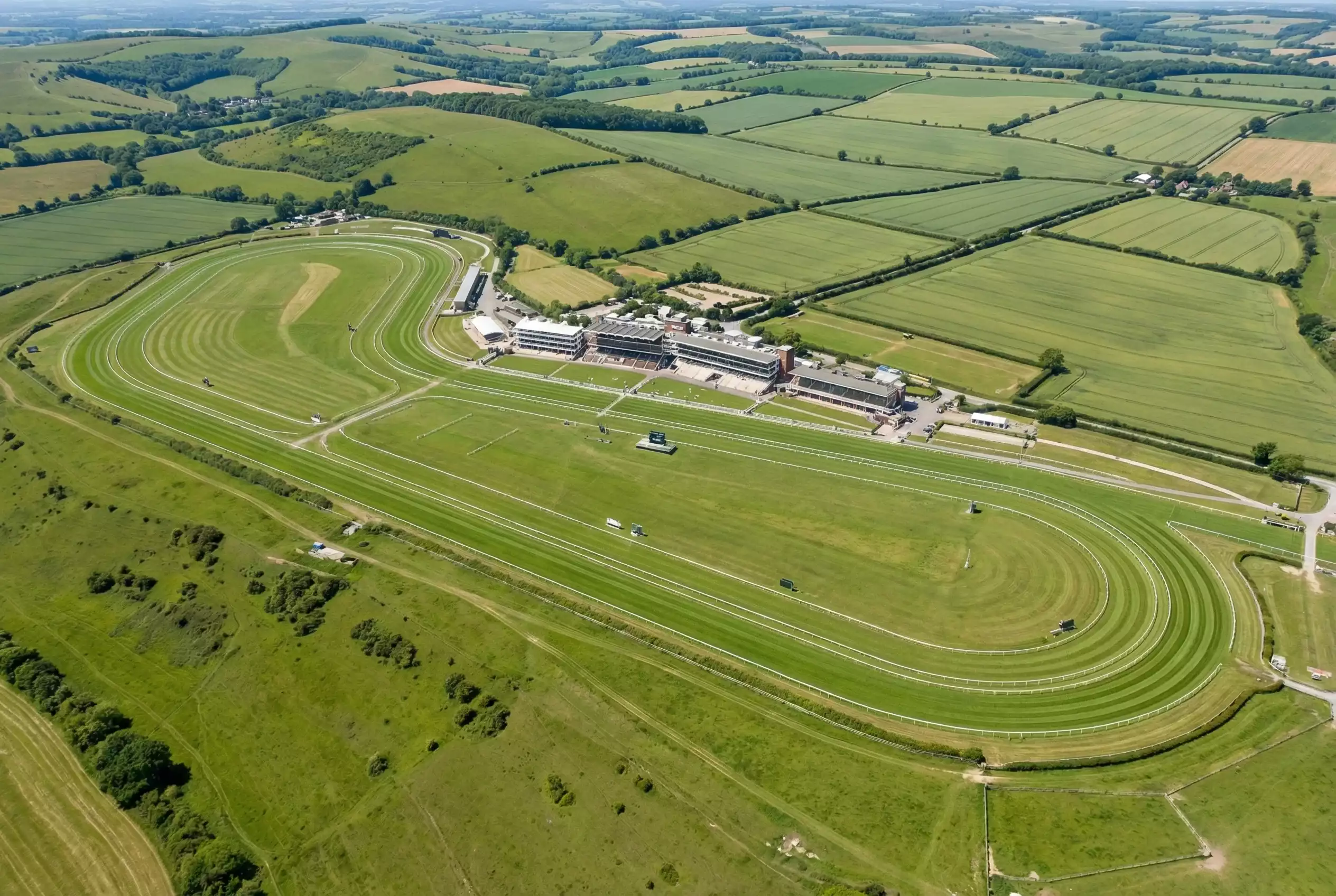
Racing on a Hillside
Goodwood course map betting strategy begins with a single fact that separates this track from almost every other racecourse in Britain: Goodwood is built on a hillside. Perched on the Sussex Downs above Chichester, the course sits at around 500 feet (149 metres) above sea level — an elevation that exposes it to coastal winds, gives it a pronounced right-hand camber, and creates the undulating terrain that makes races here consistently different from those run on flat, galloping tracks like Newmarket or York.
The track has hosted racing since 1802, giving it more than 220 years of competitive history on a layout that has changed remarkably little. That longevity means the form data is deep, the quirks are well-documented, and the horses and trainers who thrive here tend to do so repeatedly. For punters, understanding the physical layout is not an academic exercise — it is the foundation on which every selection should be built. A horse’s form at Ascot, Newmarket, or Doncaster tells you what it can do on level ground. Only Goodwood form tells you what it can do on a hillside.
The Duke of Richmond, Goodwood’s chairman, has spoken of the partnership with Qatar as making an enormous contribution to horse racing in the UK — and it is that investment, combined with the course’s unique physical characteristics, that keeps Goodwood at the centre of the British flat racing calendar. What follows is a distance-by-distance breakdown of the track, the gradients that shape every race, and the practical betting implications of a course like no other.
Goodwood Racecourse Guide — More on this topic at goodwood betting.
Course Configurations by Distance
Goodwood operates multiple course configurations, and the start position, route, and character of the race change significantly with each distance. The five-furlong course is essentially straight, running from a chute on the far side of the track towards the stands. It has a gentle downhill start that allows horses to build speed immediately, and it is widely regarded as one of the fastest five-furlong strips in the country. The short distance means that early position and stall draw are decisive — there is simply no time to recover from a slow break or a wide draw.
The six-furlong course shares the same finishing straight but starts further back, introducing a slight right-hand curve at the beginning that gives horses on the inside rail a marginal advantage in ground covered. At six furlongs, the draw bias is pronounced: low numbers are statistically favoured because they have a shorter path through the early bend and reach the straight in better position. Races like the Stewards’ Cup, run over this distance, are shaped by the draw as much as by form.
At seven furlongs, the character shifts. The start is on the far side of the course, and runners negotiate a sweeping right-hand turn before entering the home straight. This configuration introduces tactical complexity: jockeys must balance the desire to be prominent against the risk of going wide through the bend. The draw still matters, but its influence is shared with pace and positioning.
The one-mile course begins further back still, and the first two furlongs run slightly uphill before the track levels and descends towards the turn. This uphill start naturally moderates the early pace, which is why mile races at Goodwood often develop into a strong-finishing contest rather than a front-runner’s benefit. The draw is less significant at a mile because the long finishing straight — approximately three and a half furlongs — gives horses time to find a position regardless of their starting stall.
At a mile and two furlongs, a mile and four furlongs, and two miles, the course utilises the full loop. Runners start on the far side, travel right-handed through undulating terrain, negotiate the downhill turn into the straight, and then face the uphill climb to the line. These longer distances are genuine stamina tests where the gradients drain energy and tactical awareness becomes the defining factor. Front-running is progressively riskier as the distance increases, because the course profile punishes any horse that sets too strong a pace through the undulations.
Gradients, Cambers and Undulations
The word most commonly used to describe Goodwood’s terrain is “undulating,” but that single adjective undersells the complexity. The course does not simply go up and down — it also slopes laterally. The right-hand camber, running from the inside rail towards the stands side, is a constant feature that affects every race at every distance. Horses running on the stands side of the track are effectively running on a slope that pushes them towards the rail, while those on the far side must resist the camber pulling them off their line.
The most significant gradient change occurs between the three-furlong marker and the turn into the home straight. For races of seven furlongs and beyond, this section involves a descent that gains pace rapidly before the track levels for the turn. Horses that are not balanced through this transition can lose lengths, particularly on softer ground where the downhill section becomes slippery. Jockeys who know Goodwood — and there is a measurable advantage to riding experience here — manage this descent by steadying their mount slightly before committing to the turn.
The uphill finish is the most visible gradient and the one that catches out the unprepared. The final furlong and a half rises steadily to the winning post, and it transforms what looks like a comfortable lead at the two-furlong pole into a desperate struggle by the line. Horses bred for flat, fast tracks sometimes appear to hit a wall in the closing stages, not because they lack stamina in the traditional sense, but because the gradient asks their muscles to do something they have not been trained for. Course form at Goodwood is not just about knowing the horse has been here before — it is about knowing that its body can handle the specific physical demands of the terrain.
The combination of camber and gradient creates pockets of advantage and disadvantage that vary by distance and by the position of the running rail. When the rail is positioned on the stands side, the inside rail offers the shortest route but runs along the steepest part of the camber. When it is on the far side, the inside route is flatter but may be on ground that has taken more wear. Checking the rail position before the race is a small detail that experienced Goodwood punters never overlook.
Home Straight and Finish Line
Goodwood’s home straight is approximately three and a half furlongs long, which is generous by British standards and has a direct impact on race dynamics. A long straight gives hold-up horses time to make up ground, which is why closers perform well at a mile and beyond. At shorter distances — five and six furlongs — the straight represents a larger proportion of the total race distance, and the horse that enters it in front has less ground to cover while maintaining position. The straight does not favour one running style universally; its effect depends on the trip.
The surface in the straight typically rides faster than the rest of the course because it receives more maintenance attention and drains efficiently. In late July, when the festival takes place, the straight is usually at its firmest, producing quick times in the final two furlongs. That speed on the surface, combined with the uphill gradient, creates a paradox: horses can accelerate on the firm ground, but the hill punishes sustained acceleration. The result is that finishing times at Goodwood are not directly comparable to those at flat tracks, even when the going description is nominally the same.
For punters, the straight’s characteristics reinforce two principles. First, sectional times through the final three furlongs are more informative than overall race times, because they capture the specific demands of the finish. Second, horses that finish strongly at Goodwood — making up ground through the final furlong on the hill — demonstrate a physical aptitude that is repeatable. A horse that closed well here last time is more likely to close well here next time, because the hill selects for a particular type of stamina and action.
What the Layout Means for Betting
The practical betting implications of Goodwood’s layout distil into a handful of principles that apply across the festival. At five and six furlongs, the draw is king. Low stalls have a structural advantage because they sit closer to the rail on a cambered track, and that advantage is magnified in large fields where wide runners cannot cross without losing ground. When assessing a sprint at Goodwood, check the stall number before you check the form.
See also Pace Analysis at Goodwood.
At seven furlongs, the draw still matters but shares influence with pace. Horses drawn low benefit from the shortest route through the bend, but a horse drawn high that has the natural speed to cross and take the rail can overcome the disadvantage. At this distance, the interaction between draw and running style is more important than either factor in isolation.
At a mile and beyond, the draw fades as a factor and the uphill finish becomes dominant. Closers and horses with proven stamina thrive because the straight is long enough to make up ground and the gradient punishes those who set the pace. Back horses with strong finishing records and be cautious with front-runners whose form was earned on flat tracks.
At two miles, the layout becomes a full stamina examination. The undulations through the first mile sap energy, the descent into the straight demands balance, and the uphill finish demands reserves. Front-running at two miles on this course is an act of bravery bordering on recklessness. The horse that wins the Goodwood Cup is almost always the one that travelled most efficiently through the terrain, conserving energy for the final hill. Bet accordingly: tactical versatility and proven course form are the two most reliable indicators of success at the longest distances.
