
 Available in US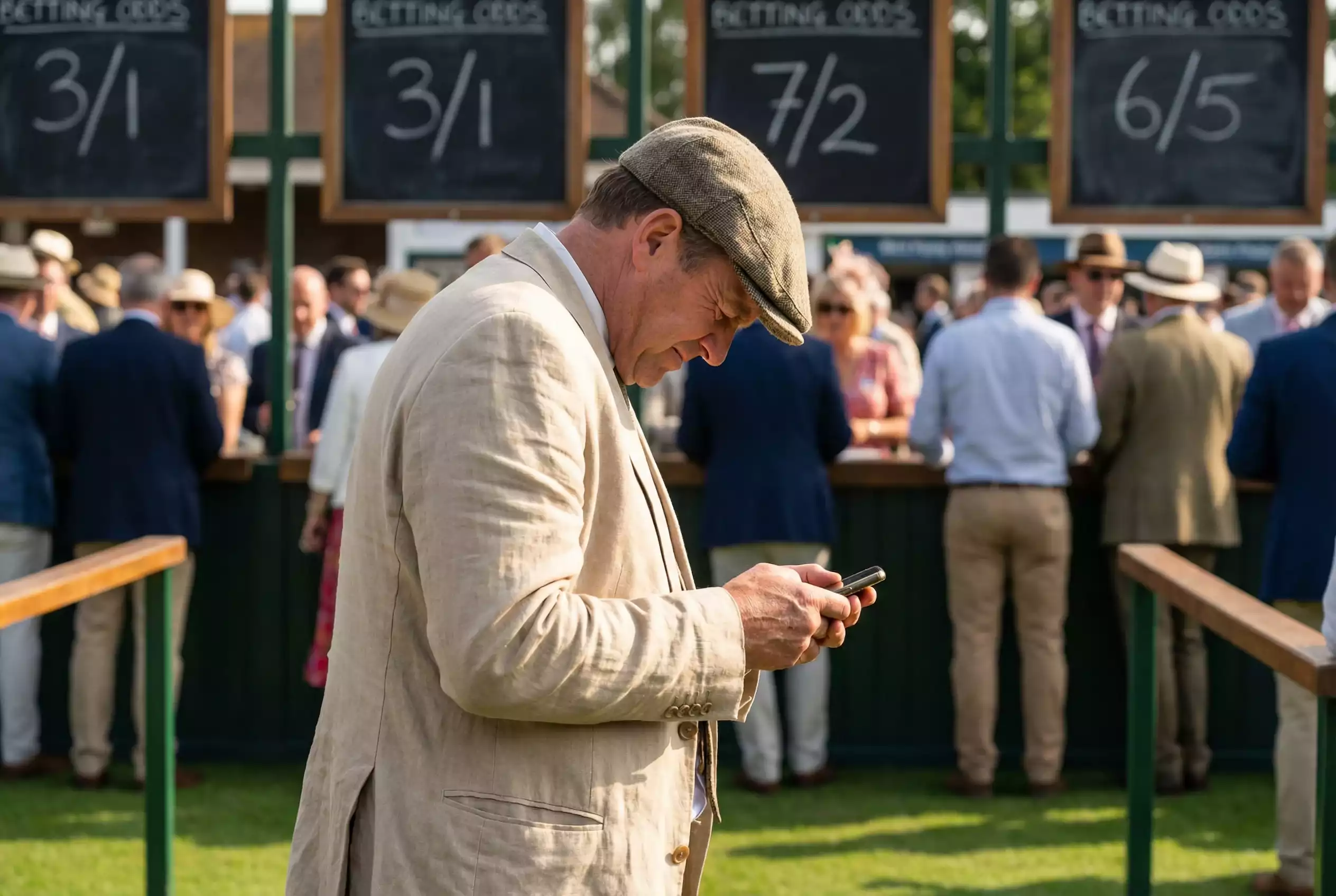
The Price Is Wrong
Value betting Goodwood is not about finding winners. It is about finding prices. The distinction sounds academic until you consider this: a punter who backs the winner of every race at odds-on will lose money over time because the payout never adequately compensates for the inevitable losers. A punter who backs horses at prices higher than their true probability of winning — even if those horses lose more often than they win — will profit over any sufficiently long run. The price is wrong, and that is where the profit lives.
Value exists whenever the bookmaker’s odds imply a lower probability of winning than you believe the horse actually has. If you assess a horse’s chance of winning at 25% and the bookmaker is offering 5/1 — which implies a 16.7% chance — the price overstates the risk and understates the horse’s prospects. That gap between your assessment and the market’s assessment is your edge. It does not guarantee a win on any single bet, but it guarantees long-term profitability if your assessments are accurate over time.
The challenge at Goodwood is that the market is relatively efficient. Bookmakers employ teams of traders and pricing algorithms, and the major races attract enough liquidity that obvious mispricings are corrected quickly. Finding value at the festival requires doing work that the market has not fully priced in — integrating draw data, going conditions, pace analysis, and course-specific trends into a probability estimate that is more accurate than the bookmaker’s. That is not easy. But it is possible, and the tools to do it are available to anyone willing to invest the time.
Value Betting at Goodwood — More on this topic at goodwood betting.
Implied Probability: Converting Odds to Percentages
Every set of odds can be converted to an implied probability, and learning this conversion is the first step towards value betting. The formula is simple: divide one by the decimal odds. A horse at 4/1 — which is 5.0 in decimal — has an implied probability of 1 divided by 5.0, which is 0.20, or 20%. A horse at evens has an implied probability of 50%. A horse at 10/1 has an implied probability of approximately 9.1%.
The critical insight is that implied probabilities across all runners in a race will always add up to more than 100%. That excess is the overround — the bookmaker’s margin. In a typical Goodwood handicap with sixteen runners, the overround might be 125%, meaning the implied probabilities sum to 125% rather than the 100% that a fair market would produce. The extra 25% is the bookmaker’s built-in profit, extracted from every punter who bets without adjusting for it.
The Gambling Commission reported that gross gambling yield from remote horse racing betting reached £766.7 million in the year to March 2025. That figure represents the aggregate overround extracted from punters across the country. Every time you accept odds without checking whether they represent fair value, you contribute to that number. Every time you find an overlay — a price that exceeds the horse’s true probability — you take a small amount back.
To adjust for overround, divide each horse’s implied probability by the total of all implied probabilities. If the overround is 125% and a horse’s raw implied probability is 20%, the adjusted probability is 20 divided by 125, which is 16%. If you believe the horse’s true chance is 20% and the adjusted market gives it 16%, you have found a potential value bet. The adjustment is a necessary step because raw implied probabilities inflate every horse’s apparent chance to accommodate the bookmaker’s margin.
Creating Your Own Tissue Price
A tissue price is your personal estimate of each horse’s chance of winning, expressed as a percentage. Professional bookmakers create tissues before every race — it is how they set the opening odds. As a punter, building your own tissue before comparing it to the market is the most structured way to identify value. The process does not require a degree in mathematics. It requires a systematic assessment of the factors that matter most at Goodwood.
Start with a base assessment from the form. If a horse has won two of its last five starts in competitive handicaps, a starting point of 15% to 20% is reasonable for a twelve-runner field. Adjust upwards if the horse has won at Goodwood before, because course form at this track is a stronger indicator than at most venues. Adjust upwards again if the draw favours it — at sprint distances, a low draw adds a measurable edge that might warrant a two to three percentage point increase.
Going conditions are the next adjustment. If the horse has a strong record on good to firm ground and today’s going is good to firm, leave the probability unchanged. If the going has shifted to good or good to soft overnight, reduce the probability by three to five percentage points, depending on how sensitive the horse is to ground conditions. This adjustment is where many punters under-invest their analysis — a going change that looks minor on paper can be worth several lengths on the track.
Pace is the final major factor. If the likely pace scenario favours your horse’s running style — a strong pace for a closer, a slow pace for a front-runner — add a couple of points. If the pace works against it, subtract. The total should reflect your honest assessment of the horse’s chance, incorporating all available information. Compare that total to the bookmaker’s implied probability, and if your number is meaningfully higher, you have found a value bet.
The discipline is to build the tissue before you look at the prices. If you see the odds first, your assessment will be anchored to the market’s opinion rather than your own. Work blind, write down your percentages, and only then compare them to the bookmaker’s odds. The bets that emerge from this process are your strongest plays of the day.
Market Signals: Steamers, Drifters and Late Money
Market movements tell you what other people think, and at Goodwood, some of those people are very well-informed. A steamer — a horse whose price contracts sharply — indicates that significant money is coming in, often from connections or professional punters who have access to information the public does not. A horse that opens at 10/1 and is backed down to 6/1 within an hour has attracted serious support, and the implied probability shift from 9.1% to 14.3% reflects a genuine upgrade in the market’s confidence.
Drifters — horses whose price lengthens — send the opposite signal. If a horse moves from 5/1 to 8/1 without any obvious explanation, the market is telling you that informed money has moved elsewhere. Sometimes a drift has a concrete cause: a negative going report, a poor warm-up, a rumour of a setback. Sometimes the cause remains hidden. Either way, a drifting price is information, and ignoring it in favour of your pre-race assessment carries risk.
Late money — significant bets placed in the final minutes before the off — is the most contested signal. Some late money is informed and profitable. Some is panic-driven or speculative. The difficulty is distinguishing one from the other in real time. A practical rule is to note late money as a supporting factor rather than a primary one: if your tissue already identifies a horse as value and late money confirms it, your confidence should increase. If late money contradicts your tissue, pause and reassess rather than blindly following the market.
Applying Value Thinking Across the Festival
The Goodwood races most likely to produce value bets are the big-field handicaps. In a 28-runner Stewards’ Cup or a 16-runner heritage handicap, the bookmaker must price every runner individually, and the more runners there are, the wider the margin for error. The overround in a 28-runner field is enormous, which means the bookmaker has room to misprice several runners without jeopardising their overall margin. Your job is to find those mispricings.
See also Goodwood Handicap Races.
The 2024 Stewards’ Cup illustrated the point: Get It won at 40/1, setting a course record in the process. A result that extreme does not happen because the form was unreadable — it happens because the market failed to assign the correct probability to a horse whose profile, draw, and fitness were all pointing in the right direction. Punters who had done the work on draw bias, weight trends, and recent fitness would have had Get It at a higher tissue price than the market suggested. They would still have been backing a longshot, but a longshot whose odds significantly exceeded its true probability — the textbook definition of a value bet.
In Group races, value is harder to find because the fields are smaller and the market is more efficient. The Sussex Stakes with eight runners is analysed more thoroughly by the market than a Tuesday handicap with eighteen. That does not mean value never exists in Group races — Qirat at 150/1 in the 2025 Sussex proved otherwise — but it does mean you should expect to find more and larger overlays in the handicaps. Allocate your analytical energy accordingly: spend the bulk of your pre-festival research on the big-field races where the payoff for accurate tissue pricing is greatest, and approach the Group races with a lighter touch, looking for specific circumstances — a going change, an unexposed runner — that might create a temporary mispricing.
