 Available in US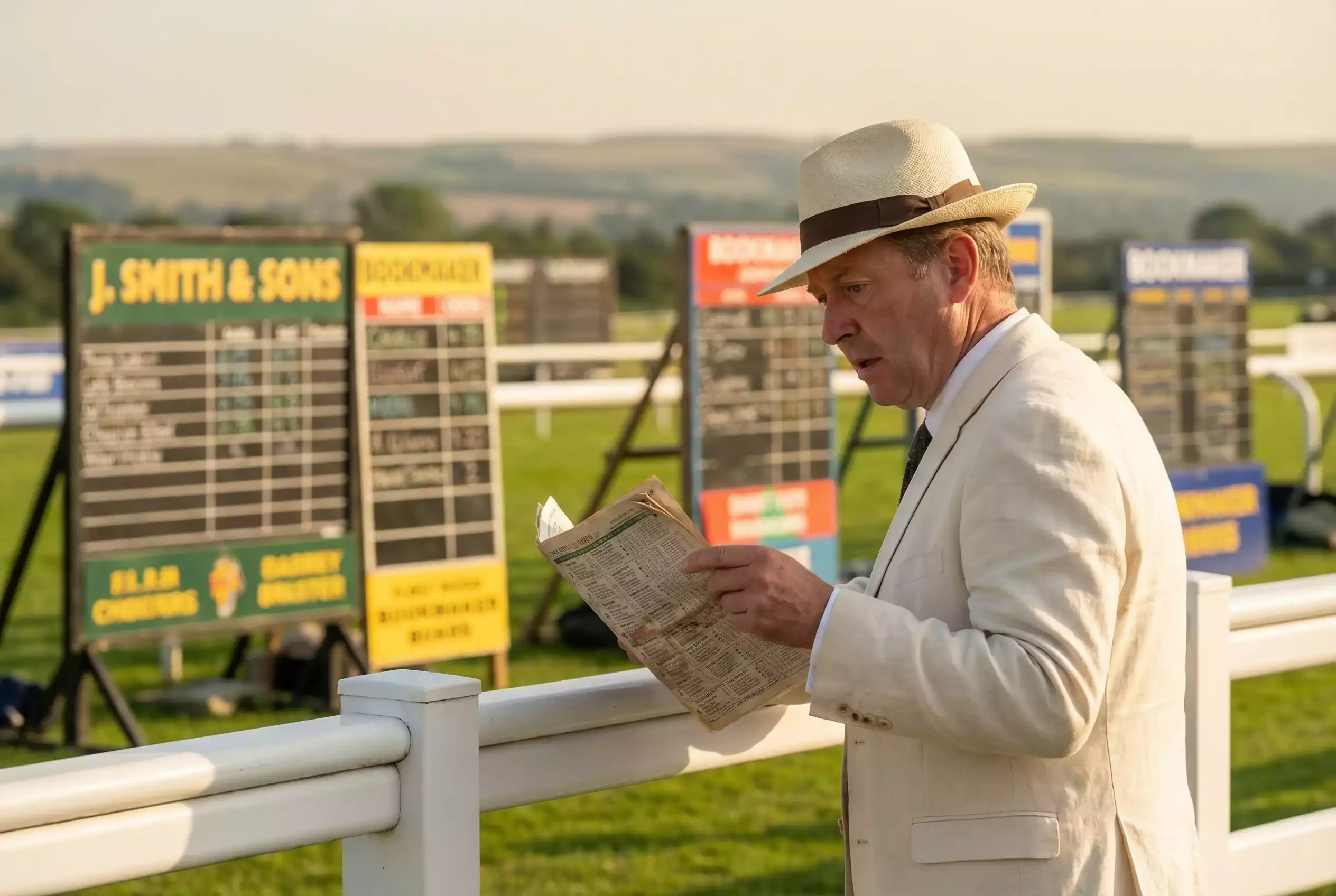
- Everything You Need Between the Gates and the Finish Line
- Goodwood Is Cashless: What That Means for Punters
- On-Course Betting Options
- Bet Types Explained: Win, Each Way, Forecast, Tricast
- Each Way at Goodwood: When It Works Best
- How to Read a Goodwood Racecard
- First-Timer Checklist
- Mobile Betting at the Racecourse
Everything You Need Between the Gates and the Finish Line
How to bet at Goodwood racecourse is a question that deserves a better answer than most websites give it. Goodwood is not a typical British racecourse. It operates as a cashless venue, which means the habits and assumptions you might bring from a day at Cheltenham, Ascot or Aintree do not all apply here. If you arrive expecting to pull a tenner from your wallet and hand it to a bookmaker, you will discover, probably at the worst possible moment, that the system works differently on this particular stretch of Sussex downland.
This guide is written for the person attending Goodwood for the first time, or for the experienced racegoer who has never actually stopped to think about whether their betting approach is suited to this specific venue. According to research compiled by the BHA, roughly 68 per cent of ticket buyers at British racecourses are casual or first-time visitors (Deep Market Insights). At Glorious Goodwood, with its festival atmosphere and five consecutive days of racing, that proportion may be even higher. There is no shame in not knowing how things work. There is only the avoidable mistake of not finding out before you go.
Goodwood is a unique track in more ways than its cashless policy. The terrain, the draw biases, the cambers, and the sprint distances all contribute to a racing environment that even experienced jockeys describe as a genuine test of skill and judgement. As one featured jockey has put it: “Goodwood is a unique track but one I love the challenge of riding. It’s such a beautiful racecourse and it’s a meeting I always look forward to” (Goodwood). Everything you need between the gates and the finish line is covered in the sections below: how to handle the cashless system, what betting options are available on course, how each bet type works, how to read a racecard, and how to use your phone for betting without missing the atmosphere.
How to Bet at Goodwood Racecourse — More on this topic at goodwood betting.
Goodwood Is Cashless: What That Means for Punters
Goodwood racecourse operates as a cashless venue. There are no ATMs on site, and the main food, drink and merchandise outlets do not accept banknotes or coins. If your usual raceday routine involves withdrawing cash at the track and using it for everything from pints to punts, Goodwood requires a recalibration (Goodwood FAQ).
The primary payment method is contactless debit or credit card. Apple Pay, Google Pay and other mobile wallet systems work at all official outlets. If you carry a card and a charged phone, you are equipped for every transaction the venue handles directly, from buying a racecard to ordering lunch in the Richmond Enclosure.
The exception, and it is an important one, is the independent on-course bookmakers. These operators, who set up their pitches in the betting ring, do accept cash. They are the one part of the Goodwood betting experience where a banknote still has currency, literally. If you prefer the tactile ritual of handing money to a bookmaker and receiving a ticket, the betting ring is where you need to be. It also means that having some cash on you, even at a cashless venue, is not entirely pointless. A twenty-pound note will not buy you a Pimm’s at the bar, but it will buy you a bet on the 3.35.
For the Tote, which operates pool betting windows at the course, the cashless rule applies. Tote bets are placed via card payment or through the Tote app. If you have never used the Tote before and want to try a Placepot or a Jackpot bet on the day, downloading the app in advance and setting up your account at home, on decent Wi-Fi, is strongly recommended. Attempting to register an account on-course, in a crowd, with patchy signal, five minutes before the first race, is a recipe for frustration.
One practical tip: bring a backup payment method. If your primary debit card declines for any reason, a limit issue, a blocked transaction, or a cracked chip, you do not want to be stranded at a venue with no cash fallback. A second card, even if it is just a prepaid one loaded with a fixed amount for the day, provides insurance that costs nothing and could save your afternoon.
On-Course Betting Options
The Qatar Goodwood Festival features 37 races spread across five days (RacingBetter), which means there is no shortage of opportunities to place a bet. Understanding what is available on the course helps you choose the method that suits your style and your budget.
The betting ring is the traditional heart of on-course wagering. Independent bookmakers set up their stands, display odds on boards, and adjust prices in real time based on the money coming in. The advantage of the ring is transparency: you can see the odds before you bet, compare prices between three or four bookmakers in the space of 30 seconds, and lock in a price the moment you hand over your stake. The price you take is the price you get, regardless of what happens to the market afterwards. At Goodwood, the ring bookmakers also accept cash, which makes them the only betting option for punters who have not embraced the cashless transition.
The disadvantage of the ring is that it requires physical presence, confidence and speed. Odds change quickly in the minutes before a race, and the best prices disappear first. If you are not comfortable making quick decisions under pressure, the ring can feel intimidating. There is also no place-only option with most ring bookmakers, each-way bets are standard, but if you want to back a horse for a place only, you will usually need to use the Tote or an online account.
The Tote operates pool betting, where all stakes on a given bet type are pooled together and the payout is determined by the total pool divided among the winners. Tote win and place bets are straightforward, but the Tote’s specialty is combination bets like the Placepot, where you pick a horse to place in each of the first six races. The Placepot is popular at festivals because it offers the possibility of a large return from a small stake, and Goodwood’s competitive fields mean that the pools are typically substantial. The Tote windows at Goodwood accept card payments, and the Tote app allows you to place pool bets from anywhere on the course.
Finally, there is the option of betting online from the course itself, which we cover in the mobile betting section. Many experienced racegoers use a combination of all three methods: the ring for win bets at the best available price, the Tote for Placepots and pool exotics, and their phone app for any late-market moves they spot while watching the parade ring.
Bet Types Explained: Win, Each Way, Forecast, Tricast
A win bet is the simplest wager in racing. You pick a horse, you place your stake, and if it finishes first you collect. If it finishes anywhere else, you lose your stake. The return is calculated by multiplying your stake by the odds. A five-pound win bet on a horse at 8/1 returns 45 pounds: 40 pounds in profit plus your five-pound stake back. If the horse finishes second by a nostril, you get nothing. Win betting is clean, binary, and merciless.
An each-way bet is two bets in one. Half your stake goes on the horse to win, and half goes on the horse to place, which at Goodwood typically means finishing in the top three in fields of eight or more runners. If the horse wins, both parts pay out: the win half at full odds and the place half at a fraction of the odds, usually one quarter or one fifth depending on the number of runners and the bookmaker’s terms. If the horse finishes second or third but does not win, the win half loses but the place half returns. A ten-pound each-way bet is actually a twenty-pound outlay, ten on the win and ten on the place, which catches out plenty of first-time punters who expect it to cost ten.
A forecast requires you to predict the first and second finishers in the correct order. A straight forecast on Horse A to beat Horse B pays out only if A wins and B finishes second. A reverse forecast covers both permutations, A first with B second or B first with A second, but costs twice the stake. Forecast dividends are determined by the Tote pool or by the bookmaker’s computer straight forecast, and they can be surprisingly large in competitive Goodwood handicaps where the first two home are both unconsidered outsiders.
A tricast extends the challenge to the first three finishers in exact order. The payouts are larger because the difficulty is exponentially greater. In a Stewards’ Cup with 28 runners, predicting the first three home in sequence is a feat that commands dividends in the thousands, occasionally the tens of thousands. Tricasts are high-risk, high-reward bets that suit punters with small stakes and a tolerance for frequent losses. They are not a staple betting strategy but can add a layer of excitement to a festival day when used sparingly.
For a first visit to Goodwood, the recommendation is to start with win and each-way bets. They are the easiest to understand, the easiest to manage, and they keep your engagement with each race straightforward. Once you are comfortable with how the odds, stakes and returns work in practice, forecasts and tricasts offer variety for the races where you feel strongly about the order of finish.
Each Way at Goodwood: When It Works Best
Each-way betting earns its keep in specific conditions, and Goodwood’s festival programme provides those conditions in abundance. The key variable is field size. In a race with five or six runners, the each-way terms are typically poor: your place portion might only pay out for the first two, and the fraction of odds is a fifth. In a race with 16 or more runners, the terms expand: place payouts cover the first four, and many bookmakers offer a quarter of the odds rather than a fifth. The bigger the field, the more generous the each-way proposition.
Goodwood’s festival handicaps, particularly the six-furlong and seven-furlong sprints, regularly attract fields of 16 to 28 runners. These are prime each-way territory. The competitive nature of handicap racing means that the first four finishers are often separated by small margins, and backing a horse each way at 14/1 in a 20-runner handicap gives you a meaningful return if it finishes anywhere in the first four. The place half at a quarter of the odds pays 3.5/1, which on a ten-pound place stake returns 45 pounds. Not a fortune, but enough to keep a day’s betting alive when the win bets are not landing.
Each-way betting works less well in small-field Group races. The Sussex Stakes, for example, might attract eight to ten runners. The each-way terms in a 10-runner race pay out on three places at a fifth of the odds. If the horse you back finishes third at 6/1, the place return is 1.2/1, which barely covers your total stake when you factor in the losing win half. In these situations, a win-only bet at the full price is often the better value, provided you have confidence in the selection.
The most profitable each-way approach at Goodwood is to target the big-field handicaps with horses priced between 10/1 and 25/1 that have solid place claims. These are the races where the market’s attention is dispersed across a large field, the each-way terms are most generous, and the combination of field size plus Goodwood’s unpredictable camber dynamics means that horses with the right profile can outrun their odds into a place finish even when they cannot win.
One trap to avoid: backing every each-way selection at the same stake. In a big-field handicap where you have strong reasons to believe a horse will place, a larger each-way stake is justified. In a borderline selection where you are half hoping rather than analysing, a smaller stake protects your bankroll. Treating each-way as a one-size-fits-all approach, rather than calibrating it to the strength of each selection, is how punters bleed money across a five-day festival.
How to Read a Goodwood Racecard
A racecard is a compressed document. Every line contains information that experienced punters decode instantly and newcomers find bewildering. The good news is that you do not need to understand every symbol on your first visit. You need to understand six things: the form figures, the weight, the draw, the trainer, the jockey, and the headgear. Everything else is refinement.
Form figures appear as a string of numbers and symbols next to each horse’s name. The most recent run is on the right. A “1” means the horse won that race. A “2” means second, “3” means third, and so on up to “9” and then “0” for tenth or worse. A dash means the horse was unplaced without a specific position recorded. A forward slash indicates a break between seasons. So a form line reading “312/04-1” tells you: third, first, second in one season, then a break, then tenth, fourth, a non-completion, and then a win in the most recent run. The pattern you want to see is recent figures in the low single digits, ideally trending downward towards “1”.
Weight is listed in stones and pounds. In a handicap, the weight reflects the handicapper’s assessment of the horse’s ability: higher weight means higher rating. In a Group race, the weights are set by age and sex allowances rather than individual ratings. At Goodwood, weight matters most in the big-field handicaps, where the difference between 8 stone 7 pounds and 9 stone 10 pounds can determine the outcome.
The draw number tells you which stall the horse will start from. At Goodwood, this is critical at sprint distances. If you have read the draw bias data for this course, you already know which stalls are favoured and which are penalised at each distance. A single number on the racecard, cross-referenced with the distance, can immediately tell you whether a horse has a positional advantage or disadvantage.
Headgear codes appear as letters next to the horse’s name. “b” means blinkers, which restrict the horse’s peripheral vision and encourage it to focus forward. “v” means a visor, similar to blinkers but with a slit for some side vision. “t” means a tongue tie, which prevents the horse’s tongue from obstructing its airway. First-time headgear, marked with a superscript “1”, is particularly worth noting: it often signals that the trainer is trying something new to improve performance, and first-time blinkers can produce dramatic improvements.
Trainer and jockey names are self-explanatory but worth noting for course-specific analysis. A horse trained by a handler with a strong Goodwood record and ridden by a jockey who excels on this track has a combination advantage that the racecard states plainly, if you know what to look for.
First-Timer Checklist
Racing is attracting new audiences faster than at any point in recent memory. In 2025, over 211,000 under-18s attended British racecourses, a 17 per cent increase on the previous year (BHA 2025 Racing Report). That growth extends to first-time adult racegoers too, and Goodwood’s festival atmosphere is a magnet for anyone curious about the sport. If you are attending for the first time, here is what you need to have sorted before you walk through the gates.
Bring a debit or credit card, and bring a backup. Goodwood is cashless for all official outlets. Your card is your wallet for food, drink, racecards and any non-bookmaker transactions. A second card provides a safety net if the first fails. Contactless payment via phone works at all points of sale, so ensure your mobile wallet is set up and your phone is charged.
Buy a racecard. It costs a few pounds and contains every piece of information you need for the day: runners, riders, form, weights, draws, and race conditions. A physical racecard is easier to annotate than a phone screen, and the act of marking it up between races is part of the ritual that makes a day at the races different from watching at home.
Check the dress code for your enclosure before you leave the house. Goodwood has tiered enclosures with different dress requirements. The Richmond Enclosure is the most formal, with a code that specifies jackets for men and smart dress for women. The Gordon Enclosure and the general admission areas are more relaxed. Wearing the wrong thing will not ruin your day, but it might restrict which areas you can access.
Set a budget. Decide before the first race how much you are prepared to lose, and treat that figure as a hard limit. A sensible approach for a first-timer is to split the budget across the day’s races, staking a fixed small amount on each. This keeps you engaged throughout the afternoon rather than blowing the lot on the second race and spending the rest of the day as a spectator. Each-way bets in the bigger fields are a gentle way to start, because even a second or third-place finish returns something.
Arrive early. The atmosphere builds through the afternoon, and the first race is often less crowded, giving you time to orient yourself, find the betting ring, and place a low-stakes bet to get the mechanics sorted before the feature races arrive. Treat the first race as a practice run. By race three, you will feel like you have been doing this for years.
Mobile Betting at the Racecourse
A significant number of racegoers now place their bets through a bookmaker’s app while standing on the course. The appeal is obvious: better odds than the on-course boards in many cases, access to best-odds-guaranteed promotions, and the ability to place a bet without queuing at a window or navigating the betting ring. At Goodwood, where the cashless infrastructure already assumes you have a phone and a card, mobile betting fits naturally into the venue’s ecosystem.
See also Going Conditions at Goodwood.
The practical consideration is signal strength. Goodwood sits on top of the South Downs, which generally provides decent mobile coverage, but large crowds concentrated in a small area can strain the network, particularly in the minutes before a feature race when thousands of people are simultaneously checking odds, placing bets, and refreshing live streams. If you plan to bet via your phone, place your bets early rather than waiting for the last two minutes before the off. A bet placed ten minutes before the race, at a locked-in price, is infinitely better than a bet that fails to process because the network is congested.
Wi-Fi is available in some enclosures at Goodwood, though its reliability under festival-day demand varies. Do not rely on it as your primary connection for time-sensitive betting. Mobile data is generally more dependable, so ensure your phone plan has sufficient data for the day, or use a temporary data pass if your allowance is limited.
The advantage of mobile betting that often goes unmentioned is price comparison. With two or three bookmaker apps open on your phone, you can compare the odds on a given horse across multiple operators in seconds. A horse might be 12/1 with one firm and 14/1 with another. Over a five-day festival, those differences in price accumulate into a meaningful difference in overall returns. The ring bookmakers offer a single price each, and while that price might move in your favour if you catch it at the right moment, the app gives you a wider market view at a glance.
The downside is distraction. Staring at a screen while the horses thunder past is a poor way to experience a day at the races. The best approach is to use the app strategically, placing your bets between races and putting the phone away for the race itself. The result will be on the screen when you check it afterwards. The spectacle of 20 horses sweeping around Goodwood’s camber at 40 miles per hour, with the South Downs stretching behind them, is something no app will ever replicate.
