
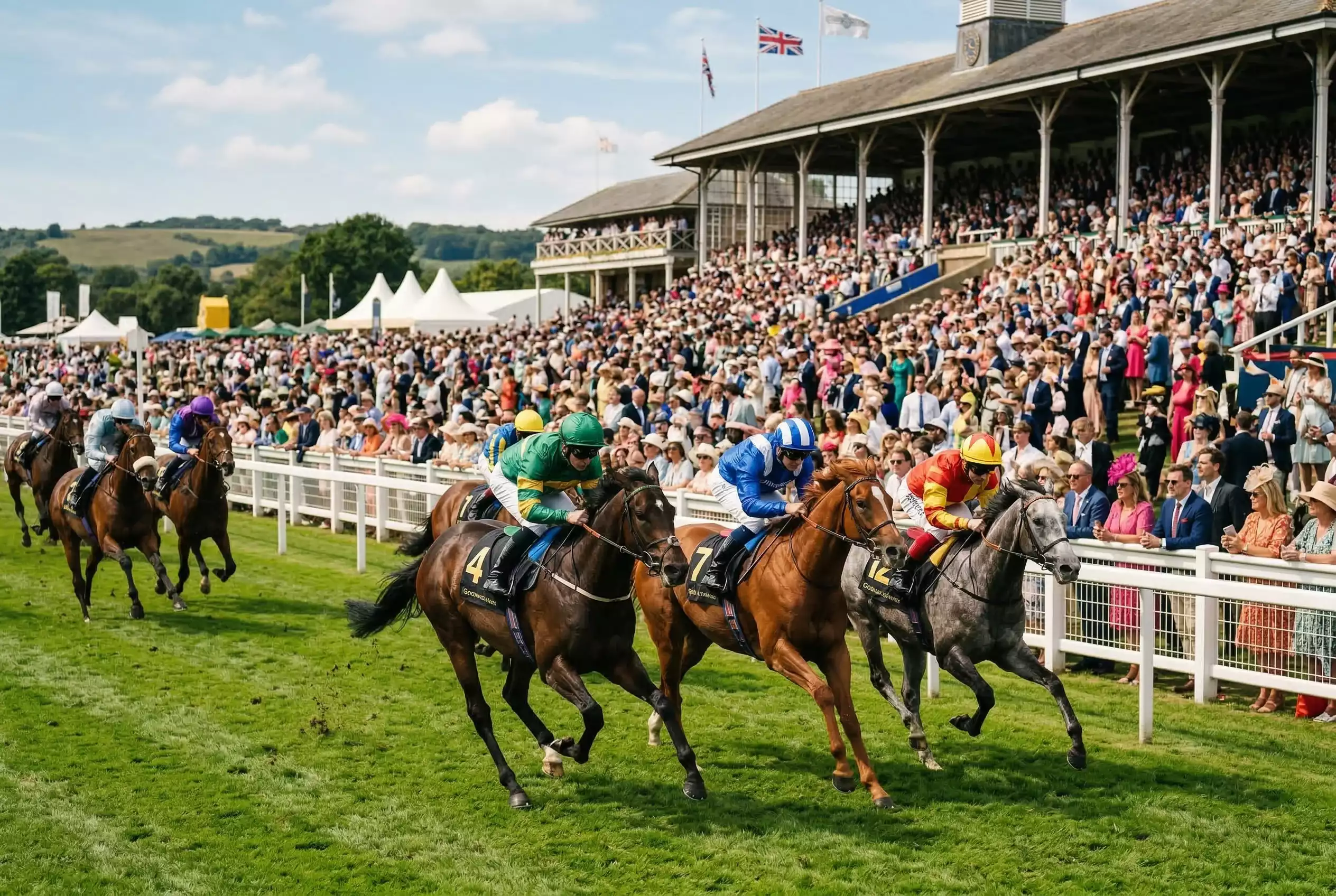
The Summer Test for the Best Middle-Distance Fillies
Nassau Stakes betting tips begin with a simple observation: this is the summer test for the best middle-distance fillies in training, and there is nowhere to hide. Run over a mile and two furlongs on the Friday of the Qatar Goodwood Festival, the Nassau brings together Classic graduates, proven Group 1 mares, and the occasional unexposed improver in a contest that consistently delivers high-quality racing and tight finishes.
The race is one of three Group 1 events staged across the five days of the festival, alongside the Sussex Stakes and the Goodwood Cup. That elite company matters because it means the Nassau is not an afterthought on the card — it is a flagship event that attracts the best fillies and mares from Britain, Ireland, and increasingly from France and beyond. The quality of entries has remained remarkably consistent, in part because the prize money makes it a target rather than a stepping stone.
For punters who specialise in fillies’ and mares’ racing, the Nassau offers something that open-age Group 1 races do not: a defined pool of form. The runners almost always come through a handful of established trials — the Oaks, the Pretty Polly, the Falmouth, the Ribblesdale — and those form lines are publicly available and well-analysed. The challenge is not finding information. It is knowing which information matters at Goodwood.
Prize Fund and Competitive Context
The Nassau Stakes carries a prize fund of £600,000, making it one of the most valuable fillies-only races in the European calendar. That figure has climbed steadily over recent years, reflecting the broader investment in top-level racing and the sponsor’s commitment to elevating each Group 1 at the festival.
Prize money at this level changes behaviour. Trainers who might otherwise wait for an autumn target — the Prix de l’Opera at Longchamp, say, or the Sun Chariot at Newmarket — are increasingly willing to run their best filly at Goodwood in July because the financial reward justifies the effort. The result is deeper, more competitive fields than the raw runner count might suggest. A six-runner Nassau with a £600,000 purse is not a weak race; it is usually a race where every entrant would be favourite in a lesser contest.
Within the broader fillies’ programme, the Nassau occupies a specific position: it sits after the Oaks, after the Irish Oaks, and after most of the early-summer trials. That sequencing means the race functions as a mid-season championship. The Oaks winner is expected to confirm her superiority. The Oaks runner-up hopes to reverse the form. And the older mares, who did not have the Oaks option, arrive with a different set of credentials — typically a strong run in the Pretty Polly or the Duke of Cambridge. Reading the race correctly means understanding which form line is most relevant to Goodwood’s specific demands.
Form Angles: Three-Year-Olds vs Older Mares
The three-year-old versus older mare dynamic is the central tension of the Nassau Stakes, and the weight allowance is the mechanism that makes it competitive. Three-year-old fillies receive a generous concession from their elders, and in a race decided by short margins that allowance has historically proven decisive more often than not. Over the past decade, three-year-olds have won the Nassau more frequently than older mares, though the older horses have had their share of dominant performances too.
When the three-year-old is an Oaks winner or placed runner arriving in good form, she deserves respect — the Classic form is the strongest public trial in Britain. But the reliability of Oaks form at Goodwood depends on the type of Oaks that was run. If Epsom produced a slowly run race where the winner came from behind, that form may not translate to a mile and two furlongs at Goodwood where the tempo is often more honest. If the Oaks was a war of attrition on soft ground and Goodwood is riding firm, the fitness benefit of having had a hard race can be offset by the different surface.
Older mares bring a different advantage: experience and physical maturity. A four-year-old mare who won a Group 2 in June has already proven she can handle the demands of a big-race day without the residual fatigue of a Classic campaign. The market sometimes underrates these horses because their form figures look less glamorous — a Group 2 victory does not carry the same cachet as an Oaks placing — but at the prices, they can represent excellent value.
The practical approach is to assess each runner on its individual merits rather than applying a blanket rule about age. Check whether the three-year-old has had a hard race recently, whether the older mare has a ground preference that matches the going, and whether either horse has experience of Goodwood’s undulations. Form angles are not formulas. They are starting points for a more nuanced assessment.
Course Factors for a Mile and Two Furlongs at Goodwood
Goodwood’s mile-and-two-furlong course starts on the far side of the track, sweeps right-handed through a gentle descent, negotiates the turn into the home straight, and then climbs uphill to the winning post. That profile tests three things that flat, galloping tracks like Newmarket do not: balance through the turn, the ability to handle undulating terrain, and the stamina to finish up a hill after racing for ten furlongs.
The turn into the straight is where races at this distance are often decided. Horses drawn wide or racing three-wide through the bend lose ground, and in a small, tightly bunched field the ground you lose at that point is difficult to recover. Jockeys who know Goodwood — those who ride here regularly — tend to position their mount on the inside rail approaching the turn, even if it means sacrificing a length of position earlier in the race. That tactical awareness is one reason why booking a Goodwood specialist as jockey carries weight in the Nassau.
Going preference is amplified on this course. Good to firm ground is the standard at the festival, and the undulations drain water away quickly after rain. But when the ground does ride softer than expected, the uphill finish becomes significantly more demanding. Fillies with a light, nimble action tend to cope better on quicker ground, while those with a more powerful, round action can handle some cut. If the going changes between declarations and race day, re-evaluating your selection based on ground preference is not optional — it is essential.
One factor that separates Goodwood’s ten furlongs from the same distance at York or Newmarket is the camber. The track is not level from rail to rail; there is a slight slope that can affect a horse’s stride pattern, particularly through the turn. Horses that have run well on flat tracks but have never encountered camber may take time to adapt, and in a Group 1 race there is no time to adapt. Previous Goodwood form, even at a different distance, provides a useful indicator of whether a horse handles the terrain.
Betting Approach: Small Fields, Strong Favourites
The Nassau Stakes typically attracts between six and nine runners, and the favourite’s record is strong. Over the past ten years, the market leader has won more often than in open-age Group 1 races, which is partly a reflection of field quality: when the best filly in Europe lines up against five or six opponents, the formbook usually identifies her correctly.
That does not mean backing the favourite is automatically profitable. Strong favourites tend to be priced at odds-on or around evens, and at those prices even one defeat in four attempts can leave you in the red over time. The profitable approach is selective rather than systematic: back the favourite when her form is rock-solid and the conditions suit, but be willing to oppose her when there is a legitimate reason to doubt the market — a ground concern, a hard recent race, or an unexposed rival stepping up in class.
Each-way betting in the Nassau is borderline. With six or seven runners, place terms apply to the first two or three, and the place part of the bet offers modest value unless you are backing a genuine outsider. If you fancy a horse at 8/1 or longer, the each-way structure can work in your favour. For anything shorter than 5/1, a win-only stake is usually more efficient.
When to oppose the market leader is the question that separates casual punters from serious ones. Look for these signals: the favourite has not run since the Oaks and the gap is six weeks or more; the going has changed since her last win; she has never raced right-handed or on undulating ground. Any one of these factors might not be enough to oppose, but two or three in combination should make you seriously consider the second or third choice in the betting.
The Nassau is a race that rewards patience and discipline. Forming a view, waiting for the right price, and staking accordingly tends to produce better long-term results than scrambling for a bet ten minutes before the off. Treat it as a single decisive wager within your festival portfolio, and make sure the odds justify the risk before committing.