
Every Symbol Tells a Story
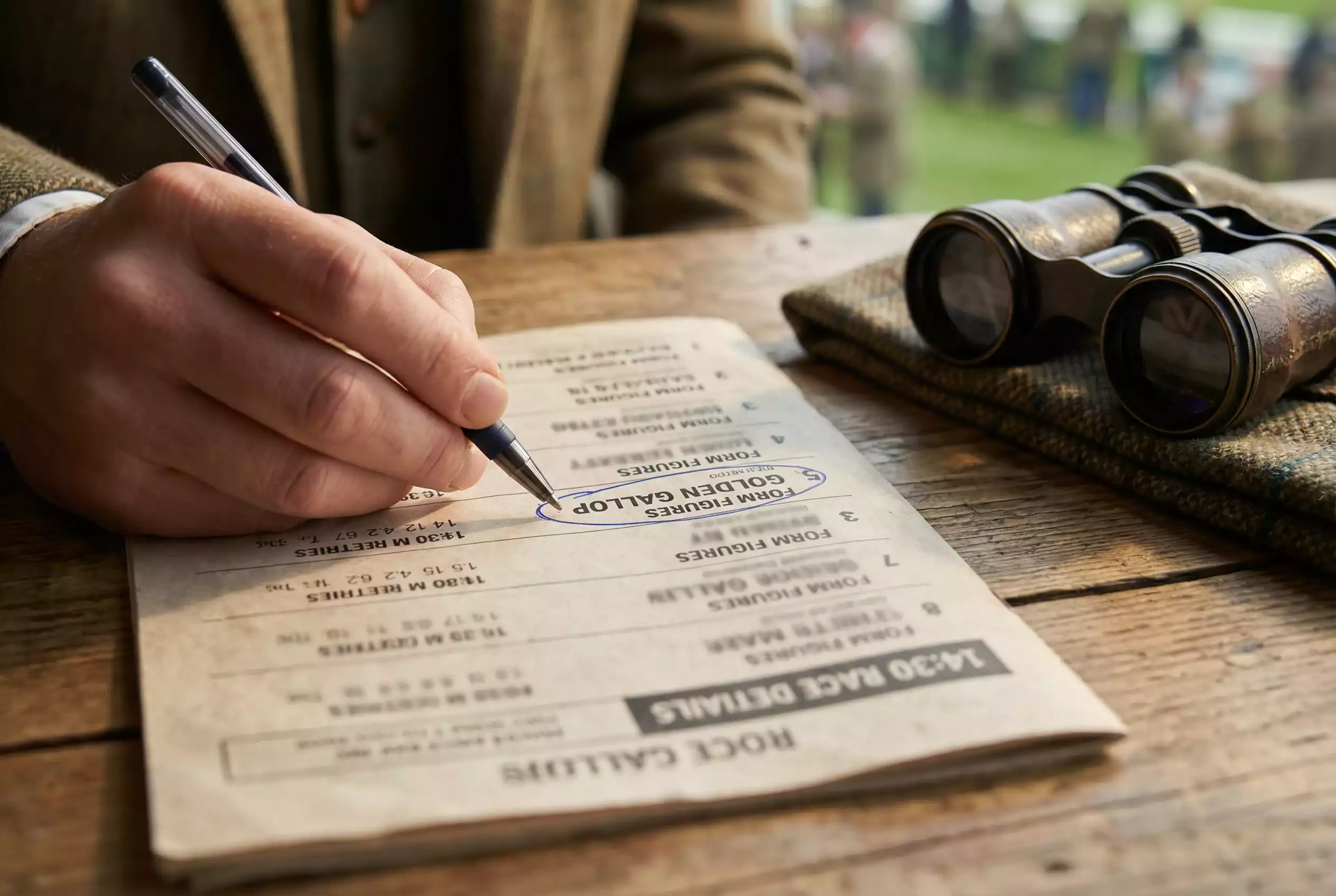
A Goodwood racecard form guide looks like a foreign language the first time you see one. Strings of numbers, letters, dashes, and abbreviations sit alongside each horse’s name in a compact grid that packs more information per square centimetre than almost any other document in sport. It is, in every sense, a coded playbook — and learning to decode it is the single most practical skill a punter can develop.
Every symbol on the racecard tells a story. A number shows where the horse finished last time. A letter reveals what equipment it was wearing. A combination of letters and numbers can tell you whether the horse has won at this course before, whether it handles the distance, and whether the trainer has changed anything since the last run. None of this information is hidden or proprietary — it is printed in every racecard sold at the track and published on every racing website. The only barrier to using it is knowing what it means.
This guide walks through each element of a racecard entry as it applies to Goodwood, from the form figures that summarise recent performance to the course form flags that highlight relevant track experience. By the end, you should be able to pick up any Goodwood racecard and extract the information that matters for your betting decisions.
Form Figures: 1-9, 0, -, /, F, P, U
The form string is the sequence of numbers and symbols to the left of the horse’s name. It reads from left to right, oldest to most recent, and each character represents one previous race. A typical form string might look like 2143-1, and once you know the code, that string tells a detailed story in six characters.
Numbers 1 through 9 represent finishing positions. A “1” means the horse won. A “5” means it finished fifth. Simple. The number “0” stands for any finishing position from tenth onwards — it does not distinguish between tenth and twentieth, so a “0” in the form is a red flag that the horse was well beaten but does not tell you exactly how badly.
The dash “-” separates racing seasons. In the example 2143-1, the dash tells you that the first four runs were last season and the “1” was this season. This distinction matters because form from a previous season may be less reliable — horses change physically over the winter, trainers adjust their programmes, and the going conditions of six months ago may bear no resemblance to today’s surface.
The forward slash “/” indicates a longer break, typically a gap of more than a year. A form string like 21/3-1 tells you the horse had an extended absence between its second and third runs, probably due to injury or time off for gelding. Horses returning from a long break can run well, but they carry fitness risk that the form figures cannot fully capture.
“F” means the horse fell, which is rare on the flat but can happen. “P” means it was pulled up — the jockey stopped riding, usually because the horse was not travelling well or was in distress. “U” means unseated rider. All three are cause for concern. A horse that has fallen, been pulled up, or unseated its rider may have a physical or temperamental issue that could recur. At minimum, investigate why it happened before backing it again.
Putting the example together: 2143-1 tells you the horse finished second, first, fourth, and third last season, and won its first start this season. That is a consistent, competitive horse that has already shown it can win in 2026. It is the kind of form string that makes you want to look deeper — and that is exactly how the racecard is designed to work.
Weight, Headgear and Equipment
Every horse carries a specified weight, printed on the racecard in stones and pounds. In handicaps, the weight is determined by the horse’s official rating — a higher-rated horse carries more weight to level the playing field. In Group races, weights are set by age and sex, with three-year-olds receiving an allowance from older horses and fillies receiving an allowance from colts. The weight each horse carries directly affects its performance, and in big-field handicaps the difference between the top weight and the bottom weight can be two stone or more.
Headgear codes appear as small letters after the horse’s name or in a dedicated column. The most common are: “b” for blinkers, which restrict a horse’s peripheral vision to help it concentrate; “v” for a visor, which is a softer version of blinkers with a small slit for partial side vision; “t” for a tongue tie, which prevents the horse’s tongue from obstructing its airway during the race; and “cp” for cheekpieces, which are attached to the bridle and focus the horse’s attention forward without fully blocking side vision.
A change in headgear from the previous run is more significant than the headgear itself. If a horse runs in blinkers for the first time — shown as “b1” on some racecards — it signals that the trainer is trying something different. First-time blinkers can produce dramatic improvement, particularly in horses that have been racing lazily or losing concentration in the closing stages. Equally, the removal of headgear that was worn previously suggests the trainer believes the horse no longer needs the help, which can be a positive or negative signal depending on context.
Other equipment to note includes the “h” for a hood, worn in the parade ring and removed before the race to help nervous horses stay calm, and “p” for a pacifier, used for similar purposes. These items do not directly affect how the horse runs but can indicate temperament issues that are worth being aware of, particularly at a busy festival like Goodwood where the atmosphere can unsettle highly strung horses.
Draw Number and Course Form Flags
The draw number appears next to each horse’s name on the racecard and represents the stall from which it will start. At Goodwood, this number matters more than at most tracks. In sprints, low stall numbers are statistically advantaged because the inside rail is the shortest route on a cambered course. At a mile and beyond, the draw is less influential but not irrelevant — at seven furlongs, the inside stalls still offer a measurable edge.
Course form flags are abbreviations that highlight relevant experience. “C” means the horse has won at this course previously. “D” means it has won over today’s distance at any course. “CD” means it has won at this course over this distance — the gold standard of relevant form. “BF” indicates the horse was beaten favourite last time, which tells you the market expected it to win and it did not. That can be a negative signal or a value opportunity, depending on why it was beaten.
At Goodwood, the “C” flag carries particular weight because the track is so unusual. A horse with previous course form has demonstrated that it can handle the undulations, the camber, and the uphill finish — physical challenges that trip up many first-time visitors. OLBG data shows that R.M. Beckett, the most profitable trainer at the course over five years with an LSP of +117.31 from 28 winners, thrives precisely because he targets Goodwood-suited horses with the right course experience. On the riding side, Oisin Murphy’s six winners at the 2025 festival — making him top jockey for the second consecutive year — underline how much track knowledge matters. Murphy himself reflected on that run of success, telling RacingBetter about the quality of rides he had been fortunate to get across a brilliant few days.
When reading a racecard, treat course form flags as filters rather than conclusions. A horse with a “CD” flag is not guaranteed to win, but it has passed a test that many of its rivals have not. Combine the flag with the draw, the going, and the form figures, and you have a much sharper picture of each horse’s realistic prospects than the odds alone can provide.
Putting It Together: A Sample Goodwood Racecard
Imagine you open the racecard for a seven-furlong handicap on Wednesday of the festival. One entry reads: draw 3, form 2131-2, weight 9st 2lbs, headgear v1, flags CD. That compressed line contains everything you need for a preliminary assessment.
Start with the form: 2131-2. This horse finished second, first, third, and first last season, then second on its seasonal debut. Consistent, competitive, and capable of winning. The dash tells you the first four runs were last year, the most recent run was this season. No long absences, no alarming gaps.
The draw is 3 — a low stall on a seven-furlong course where inside stalls have a statistical edge. That is a positive. The weight is 9st 2lbs, which is mid-range in a typical handicap — not so high that the horse is burdened, not so low that it suggests the handicapper thinks it is limited. The headgear code “v1” means it is wearing a visor for the first time, a change that suggests the trainer is looking to sharpen its focus. First-time headgear is always worth noting.
The flags are “CD” — this horse has won at Goodwood over seven furlongs before. Combined with the low draw, the consistent form, and the first-time visor, this is a horse that deserves serious consideration. It has handled the track, the distance, and competitive handicap company. The new visor hints at a tactical adjustment that the trainer believes will unlock further improvement.
Does all of this guarantee it will win? Absolutely not. But it tells you that the horse meets every reasonable criterion for a competitive run, and if its price is right — if the odds reflect its chance fairly or generously — it is a bet worth making. That is what the racecard is for: not to predict the future, but to give you enough information to make a rational decision rather than a blind guess.