
 Available in US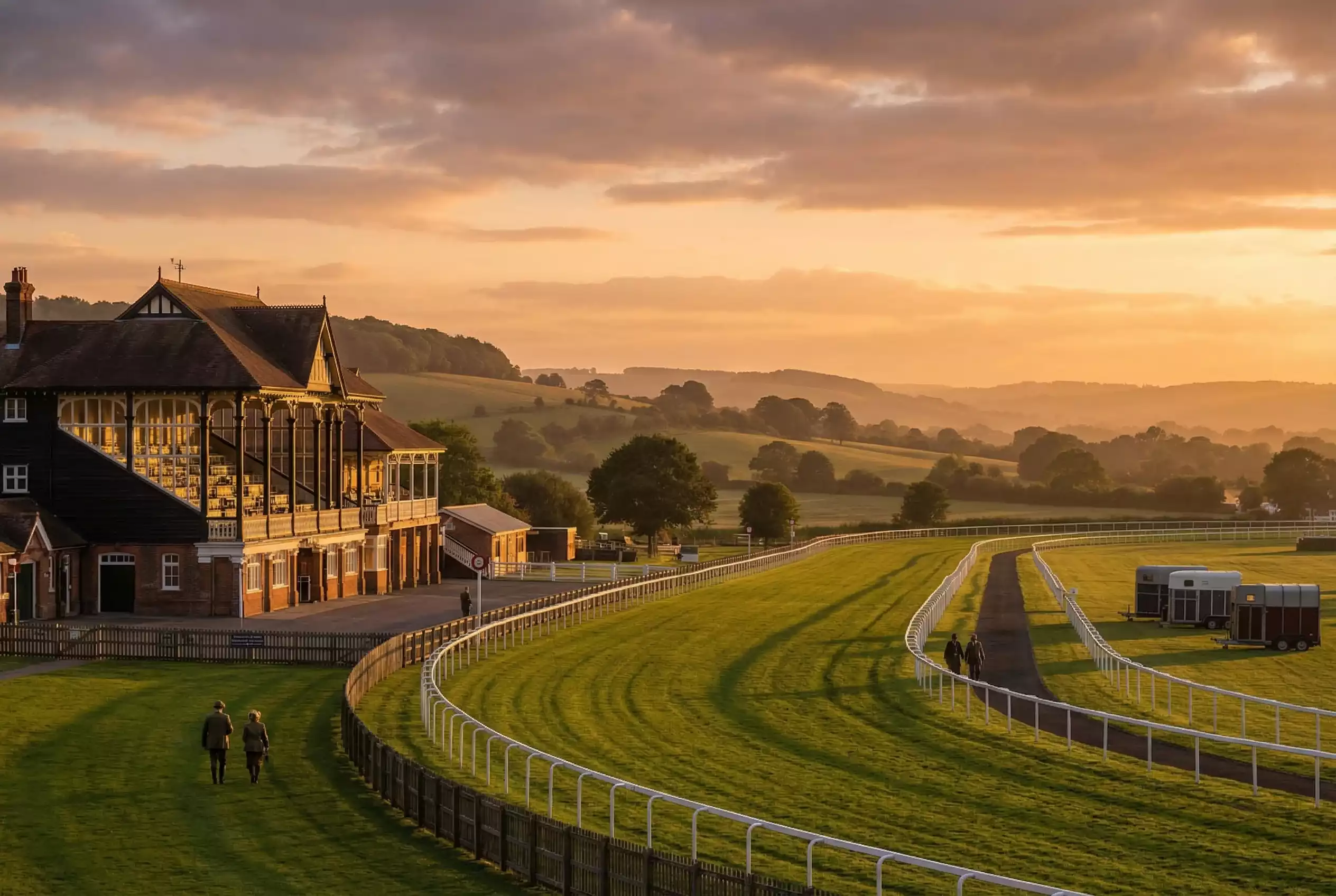
From a Duke’s Private Wager to a Million-Pound Spectacle
Goodwood racecourse history stretches back more than two centuries, from an informal gathering of horses on a private estate to one of the most prestigious flat racing festivals in the world. The arc of that story — from a duke’s private wager to a million-pound spectacle — mirrors the evolution of British racing itself, from aristocratic pastime to mainstream sporting entertainment.
What makes Goodwood’s history relevant to the modern punter is continuity. The track sits on the same Sussex Downs ridge it occupied in the early 1800s. The undulations, the camber, the exposed hilltop position — these are not modern design choices, they are geological features that have shaped racing here for every one of those 220 years. A horse that handled the terrain in 1902 faced the same fundamental challenges as one racing in 2026. Understanding the track’s origins explains why it rides the way it does and why course form matters here more than at most venues.
Goodwood Racecourse History — More on this topic at goodwood betting.
Origins: The Duke and the Downs
The first public race at Goodwood took place in 1802, organised by the 3rd Duke of Richmond on his private estate. The Duke was a passionate horseman who had been staging informal races for friends and neighbours on the Downs for some years before opening the meeting to the public. That transition — from private sport to public spectacle — was driven partly by enthusiasm and partly by economics. A public race meeting attracted visitors, and visitors spent money in the surrounding area.
The choice of location was deliberate. The Downs above Chichester offered a natural amphitheatre with long sightlines, firm chalky turf that drained well, and enough undulation to test horses properly. What the Duke could not have known was that these same features would make the course uniquely challenging for centuries to come. The right-hand camber, the uphill finish, the exposed position that catches the south-westerly wind — all of it was inherent to the site from the beginning.
The “Glorious” epithet attached itself to the Goodwood meeting during the Victorian era, when the festival became a highlight of the summer social season. The timing — late July, after Royal Ascot and before the autumn campaigns — gave it a specific identity as the summer’s farewell to top-class flat racing. Fashionable society descended on the Sussex Downs for five days of sport, socialising, and spectacle, a tradition that continues in remarkably similar form today.
By the mid-nineteenth century, Goodwood had established itself as one of the premier racing venues in England. The Stewards’ Cup, first run in 1840, became one of the most competitive handicaps in the calendar. The Sussex Stakes, introduced in 1841, evolved into a championship event for the miling division. These founding races still anchor the modern festival, giving Goodwood a depth of tradition that few racecourses can match.
Golden Age to Post-War Decline
The late Victorian and Edwardian periods represented Goodwood’s golden age. Attendance grew, prize money increased, and the meeting attracted the finest horses in training. The course benefited from the broader expansion of British racing, which saw new tracks opened and existing venues improved as the sport’s popularity surged across all social classes.
The two World Wars disrupted racing at Goodwood as they disrupted everything else. The estate was requisitioned for military use during both conflicts, and the racecourse facilities suffered from neglect. After 1945, the challenge was not just physical reconstruction but cultural repositioning: racing had to compete with new forms of entertainment, and the social cachet of a day at the races was no longer the draw it had been in the Edwardian era.
The post-war decades saw gradual modernisation. Facilities were updated, the racing programme was restructured, and efforts were made to attract a broader audience beyond the traditional racing crowd. Goodwood benefited from its location — close enough to London for a day trip, surrounded by the natural beauty of the South Downs — and from the enduring appeal of its July meeting as a festival rather than a mere race day. But by the early 2000s, the course faced the same financial pressures as much of British racing: rising costs, static attendance, and prize money that struggled to attract the best horses from increasingly globalised competition.
The Qatar Era: Sponsorship That Transformed Prize Money
The partnership between Goodwood and Qatar, signed in 2015 as a ten-year deal worth approximately £2 million per year, transformed the festival’s financial landscape. It was the largest sponsorship agreement in the history of British racing at the time, and its impact was immediate. Prize money rose sharply across the five-day programme, with the Sussex Stakes reaching the £1 million mark and the Goodwood Cup, Nassau Stakes, and supporting Group races all benefiting from significant increases.
Adam Waterworth, Goodwood’s managing director, reflected on the partnership by noting that the first four years had been positive for both parties and that the Goodwood Cup demonstrated what could be achieved by upgrading races and prize money. That assessment captures the commercial logic: higher prize money attracts better horses, better horses attract more media coverage and larger crowds, and larger crowds generate more revenue for the racecourse and its sponsors. The virtuous cycle has continued through the partnership’s extension with Visit Qatar from 2025.
The practical consequence for punters has been a measurable improvement in field quality. Before the Qatar sponsorship, some of Goodwood’s Group races struggled to attract full fields of genuine contenders. Since 2015, the festival consistently draws the best horses from across Europe, which means the form available to punters is deeper, more reliable, and more thoroughly analysed. The era of soft Goodwood fields, where a moderate horse could win a Group race because the opposition was thin, is largely over. Today’s festival demands that every runner earns its place.
Goodwood Today: Where Heritage Meets Data
Modern Goodwood is a study in contrasts. The setting is unchanged — the same Sussex Downs, the same undulating terrain, the same exposed hilltop with views across the English countryside. But the infrastructure has been thoroughly modernised. Goodwood operates as a cashless venue, with no banknotes accepted at main facilities. Data analytics inform track management, going assessments, and the racing programme itself. The festival’s social media presence reaches millions, and the betting markets that surround each race are more liquid and more competitive than at any point in the track’s history.
See also Goodwood Sprint Distances.
For punters, this combination of old and new creates unique opportunities. The terrain that has shaped racing here since 1802 still produces the same draw biases, the same pace dynamics, and the same advantage for course specialists. But the data to quantify those effects — PRB scores, LSP figures, GoingStick readings, sectional times — is now available to anyone with an internet connection. The punter who combines 220 years of accumulated track knowledge with modern analytical tools is better equipped to find value at Goodwood than at any time in the course’s history.
The heritage is not just decoration. It is the reason the track rides the way it does, the reason certain trainers and jockeys thrive here, and the reason form from Goodwood transfers differently to other courses than form from flat, modern tracks. Understanding the history is not nostalgia — it is analysis.
