
 Available in US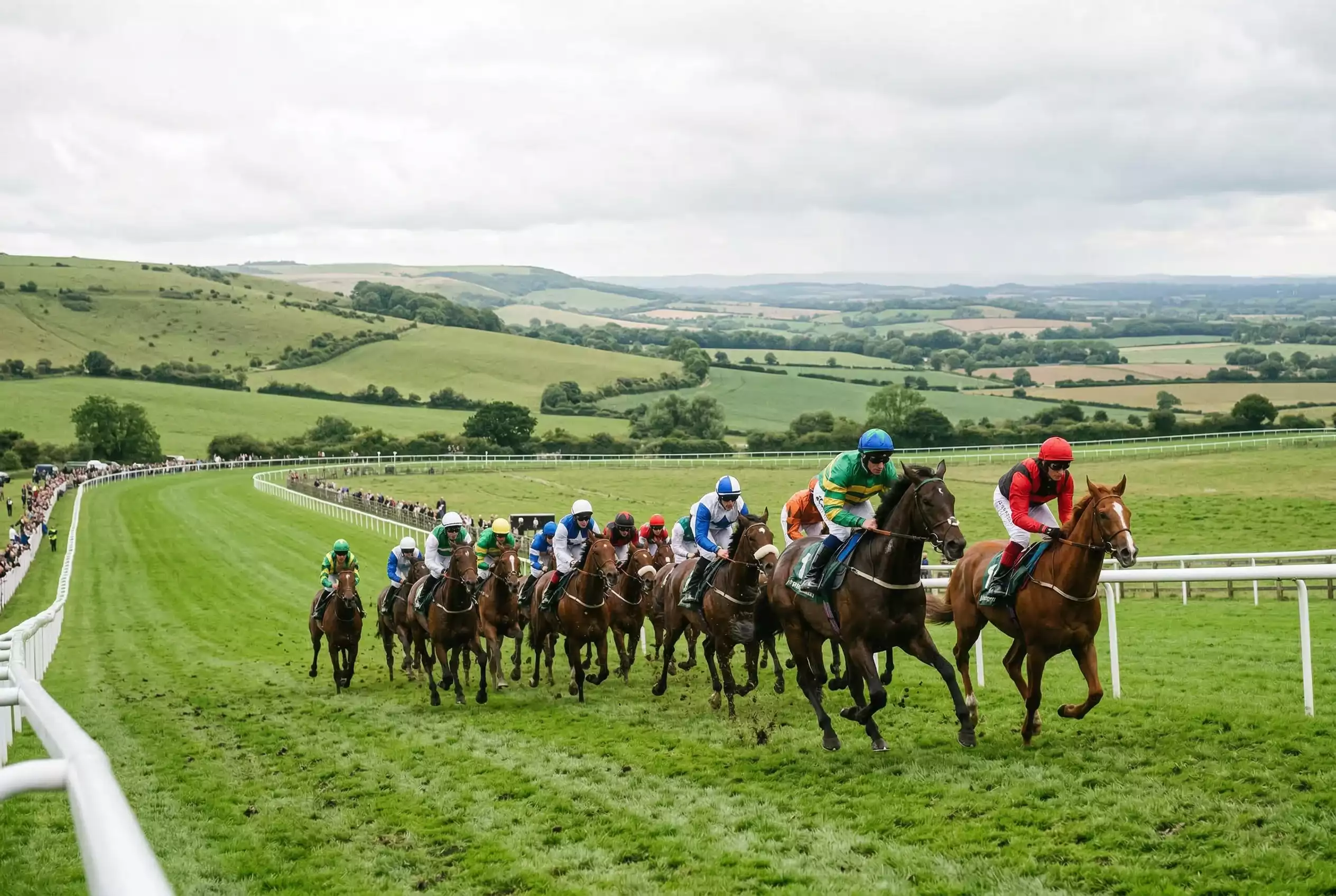
Goodwood’s Hills Sort the Genuine Stayers
Goodwood staying races are the ultimate test of whether a horse truly gets the trip. On a flat, galloping track, a horse can mask a stamina deficiency by travelling efficiently and using a burst of speed to hold on in the final furlong. At Goodwood, that approach collapses. The undulations drain reserves through the first mile, the descent into the straight demands balance, and the uphill finish asks questions that only genuine stayers can answer. Goodwood’s hills sort the genuine stayers from the pretenders, and the punter who understands that separation has a significant edge.
The staying programme at the festival is anchored by the Goodwood Cup over two miles, but the races at a mile and four furlongs and a mile and six furlongs are equally demanding and often better betting propositions because they attract larger fields with more dispersed odds. Understanding how each distance configuration works — and how the terrain affects different types of stayer — is the foundation of profitable long-distance betting at this track.
Goodwood Staying Races — More on this topic at goodwood betting.
Course Profile: 1m4f, 1m6f and 2m
At a mile and four furlongs, the course utilises much of the same loop as the two-mile course but starts further along. Runners face a sweeping right-hand turn through undulating terrain before descending to the home straight. The key feature is the downhill section approaching the turn: horses that are not balanced here lose momentum and position, and recovering that lost ground on the uphill finish is extremely difficult. This distance rewards horses that travel efficiently through terrain changes — not necessarily the fastest, but the most economical movers.
At a mile and six furlongs, the additional two furlongs extend the test further. The start is positioned to allow runners to cover the full extent of the undulations, and the race develops a rhythm that is closer to a staying event than a middle-distance contest. Horses that have won over a mile and two furlongs on flat tracks sometimes fail to stay this trip at Goodwood, not because the distance is beyond them in absolute terms, but because the terrain adds an energy cost equivalent to an extra furlong of running on the level.
At two miles, the Goodwood Cup distance, the course is at its most demanding. Runners navigate the full loop, experiencing every gradient change the track offers. The race is run at a pace that appears moderate but is deceptive: the undulations mean that horses are constantly adjusting their effort, accelerating downhill and straining uphill, in a way that flat two-mile races do not require. By the time the field enters the home straight, the cumulative fatigue is visible — horses that looked comfortable at halfway can fall away dramatically in the final two furlongs, while those that conserved energy through the early stages finish with authority.
What Stayer Form to Trust
The Ascot Gold Cup is the primary form reference for the Goodwood Cup, and its reliability has been tested by generations of stayers. The connection is direct: both races are Group 1 events at two miles, run within five weeks of each other, and often share several runners. But the form does not transfer uniformly. Ascot is flat and galloping, which allows horses to maintain a consistent rhythm. Goodwood’s undulations disrupt that rhythm, and horses that won at Ascot through sustained grinding may not reproduce the form when asked to adapt their stride pattern to the terrain.
Stradivarius’s four consecutive Goodwood Cup victories between 2017 and 2020 demonstrated what the perfect Goodwood stayer looks like: tactically versatile, physically balanced through undulations, and capable of quickening on the uphill finish regardless of the pace. Aidan O’Brien’s five wins over twenty years — with Yeats, Kyprios, and Scandinavia — show that the Ballydoyle operation understands the specific demands of this race and targets it with horses suited to the challenge.
Progressive stayers entering their peak season deserve particular attention. A four or five-year-old that has stepped up in trip during the spring and produced improving form at a mile and six furlongs or two miles is the archetype of a Goodwood Cup improver. These horses arrive with momentum that the market may not fully price, especially if their form was earned at less prominent meetings where the public analysis is thinner.
Trainer patterns at staying trips are unusually informative at Goodwood. The course’s unique demands mean that trainers who have won here before tend to understand what type of preparation is required. A trainer sending a runner to the Goodwood Cup for the first time is operating without the institutional knowledge that comes from previous experience. When faced with a choice between two similarly rated stayers, the one from a yard with proven Goodwood Cup form is the safer bet.
Pace at Staying Trips
Pace at two miles on this course is tactical rather than sustained. Small fields — typically six to ten runners in the Goodwood Cup — mean that jockeys are wary of committing too early. The result is often a slow first mile followed by a gradually quickening second mile, with the decisive move coming inside the final three furlongs. This setup rewards horses with a turn of foot rather than those who grind out relentless galloping.
When the pace is slow, the finish becomes a sprint, and the horse with the best acceleration wins. When the pace is strong — either because a confirmed front-runner forces the issue or because multiple jockeys decide to be positive — the finish becomes a war of attrition, and the horse with the deepest stamina reserves prevails. Identifying the likely scenario before the race, based on the running styles of the declared runners, is one of the most valuable pieces of pre-race analysis at staying trips.
Front-running at two miles on this course is a particularly high-risk strategy. The horse setting the pace absorbs all the effort of navigating the undulations while those behind get a tow. By the time the field enters the home straight, the front-runner has been working harder than any other horse for the full distance. Unless it possesses extraordinary stamina — and very few horses do — it will be caught on the hill.
Staying Race Betting Approach
Small fields compress the odds and limit the value available in win markets. The Goodwood Cup favourite typically trades at 2/1 or shorter, and in a six-runner field the second and third choices are often 3/1 and 5/1 respectively. Each way terms are thin — only two or three places paid — which means the standard each way approach that works in big-field handicaps is less effective here.
See also Best Betting Apps for Goodwood.
Win-only betting on the horse you believe has the best combination of stamina, course suitability, and tactical versatility is the most efficient approach. If you do not have a strong view, the staying races are worth sitting out rather than forcing a bet at cramped odds. The stakes you save can be redeployed more productively in the bigger-field handicaps elsewhere on the card.
Ground preference is the single most important variable to check before committing to a staying-race bet. Over two miles, the going amplifies every advantage and disadvantage: a horse suited by the ground will travel more efficiently through the undulations and arrive at the finish with more energy. A horse racing on its least preferred surface will expend extra effort with every stride, and over two miles those small inefficiencies accumulate into a decisive disadvantage. If the going has changed since you formed your view, reassess before the off. At staying trips, ground is not a secondary consideration — it is the primary one.
