
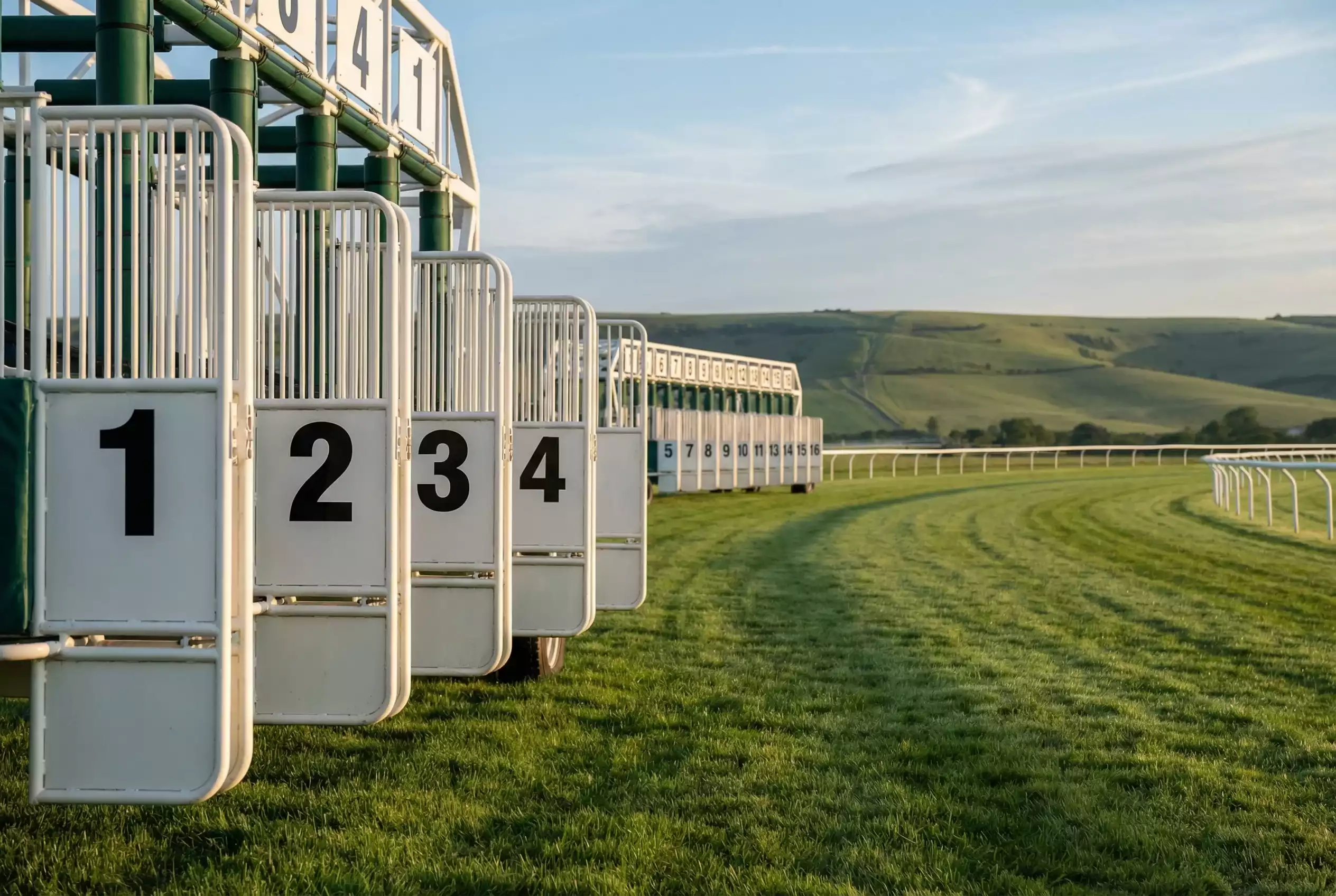
- Why the Draw Matters More at Goodwood Than Almost Anywhere Else
- How Goodwood's Topography Creates Draw Bias
- 5-Furlong Sprints: Inside Rail Dominance
- 6-Furlong Draw: The Stall 7 Penalty
- 7-Furlong Bias: Low Stalls Edge
- Mile and Beyond: Where Draw Fades
- Draw Heatmap: All Stalls Across All Distances
- Pace and Draw: When Front-Runners Override the Stall
- Practical Filters: Using Draw in Your Selections
Why the Draw Matters More at Goodwood Than Almost Anywhere Else
Goodwood draw bias is not a footnote in your racecard analysis. It is, at certain distances, the single most predictive variable you can study before placing a bet. That claim sounds aggressive, and it should, because the data behind it is aggressive too. Over five years of results on this unique Sussex Downs layout, specific stall-and-distance combinations have generated Level Stakes Profits above +150, while others have bled punters dry at rates that would embarrass a broken slot machine. Where you start changes where you finish, and at Goodwood that principle operates with a clarity you simply will not find at Ascot, York or Newmarket.
The reason sits in the topography. Goodwood is not a flat, galloping oval. It is a right-handed, undulating course draped across chalk downland, with cambers that tilt the racing surface towards the outside rail on key bends. Horses drawn high on sprint distances are not merely starting wide; they are starting on the wrong side of a slope that will push them wider still as the field compresses into the first turn. On a fast summer afternoon, with the ground reading good to firm, that positional disadvantage translates directly into lost lengths and, ultimately, lost money.
Seamus Buckley, the clerk of the course, has described the ideal Goodwood surface as “good to firm with a little moisture and a grass length of around four inches” (Racing Post). When the ground is at that baseline, the draw bias peaks. The rail is fastest, the camber is most punishing, and the data separating low stalls from high stalls stretches to its widest. Soften the ground with overnight rain, and the picture shifts because the inside rail cuts up and horses spread across the track. Understanding draw bias at Goodwood therefore requires understanding it as a dynamic variable, not a fixed rule.
This article breaks down the stall position data distance by distance, using five-year LSP (Level Stakes Profit) figures from OLBG and PRB (Percentage of Rivals Beaten) analysis from Geegeez. The goal is not to hand you a single rule. It is to give you a filtering system: distance first, stall second, pace style third, going conditions fourth. By the final section, you will have a practical checklist that narrows your Goodwood selections before you even look at form.
How Goodwood’s Topography Creates Draw Bias
Most British racecourses sit in river valleys or on reclaimed heathland. Goodwood sits on top of the South Downs, at an elevation of roughly 100 metres above sea level, and that altitude brings terrain features you will not encounter at sea-level tracks. The course loops around the northern shoulder of a chalk ridge, which means the racing surface is never truly flat. There is always a gradient, and that gradient has consequences.
The most important feature for draw analysis is the right-handed camber through the middle section of the track. On distances that include bends, particularly the 5-furlong, 6-furlong and 7-furlong trips, the inside of the track sits lower than the outside. Gravity, in the most literal sense, pulls horses towards the inside rail once they are on the bend. A horse drawn low is already on that rail. A horse drawn high has to cross the camber to reach it, covering extra ground and expending extra energy in the process. On a 5-furlong sprint that lasts barely 55 seconds, even a slight positional disadvantage can cost a length that never gets recovered.
The climb towards the three-furlong pole adds another dimension. Horses running along the inside rail take the shortest route up that incline. Horses forced wide by their draw or by traffic run the same hill on a longer arc. The cumulative effect is distance plus effort, and it compounds as the field tightens approaching the home straight.
Goodwood’s finishing straight is roughly two and a half furlongs long, and it tilts slightly downhill. This is where the topography gives something back to wider-drawn horses in longer races. At a mile and beyond, there is enough straight to recover ground lost on the bends, which is why the draw bias effectively disappears at those distances. At sprint trips, however, the straight is too short to compensate. A horse drawn in stall 12 on a 5-furlong race arrives at the top of the straight already behind on position, and there are only 500 metres of descending ground left to make it up. The arithmetic rarely works out.
One more variable: the rail position. Goodwood’s groundstaff move the running rail to protect the inside turf, and the position changes between meetings. When the rail is set with fresh ground on the inside, the low-draw advantage intensifies because that strip of turf offers better footing. When the rail is moved out to expose chewed-up ground, the bias can soften. Checking the rail position on the morning of a race day is a two-minute task that can save you an entire afternoon of misplaced bets.
5-Furlong Sprints: Inside Rail Dominance
The five-furlong course at Goodwood is one of the fastest in the country (At The Races), and it is also the distance where draw bias screams loudest. The start sits on the far side of the course, the field charges downhill into a right-handed bend, and the camber funnels everything towards the inside rail within the first furlong. By the time the runners straighten up for the final two and a half furlongs, positional damage has already been done.
The numbers tell a blunt story. According to data compiled by BritishRacecourses.org, stall 1 on the five-furlong course produces twice as many winners as any other individual stall. That is not a marginal edge. That is a structural advantage baked into the geometry of the track. The horse in stall 1 breaks on the rail, holds the rail through the bend, and enters the straight with the shortest possible route already behind it. Every other runner has to either cross the camber to reach that rail or accept a wider passage that adds metres to the journey.
Five-furlong races at Goodwood tend to be fast-run affairs. The downhill start encourages jockeys to go hard from the gate, and there is no tactical incentive to sit and wait when the race is over in under a minute. That front-running tempo amplifies the draw bias. A horse drawn in stall 1 that breaks well can establish rail position within the first 100 metres and never relinquish it. A horse drawn in stall 10 or higher would need to break significantly faster than the inside runners just to get across to the rail before the bend, and doing so burns energy that will not be available in the closing stages.
For punters, the practical application is straightforward. In any five-furlong race at Goodwood with a full field, horses drawn in stalls 1 through 4 deserve a weight of attention disproportionate to their form figures. A horse with moderate form drawn in stall 1 is a more appealing bet than a marginally better horse drawn in stall 12. That sounds like heresy if you are trained to put form above everything, but Goodwood at five furlongs is the one context in British flat racing where the stall can genuinely trump the formbook.
There are exceptions. Small fields dilute the bias because there is less congestion on the bend and wider-drawn horses can cross to the rail without losing ground. If the field size drops below eight runners, the positional advantage of stall 1 shrinks considerably. But on festival days, five-furlong sprints routinely attract double-digit fields. In those races, the low draw is not an edge. It is a prerequisite.
6-Furlong Draw: The Stall 7 Penalty
Add a furlong to the trip and the draw bias does not disappear. It reshapes. The six-furlong start at Goodwood sits further back along the course, and the field negotiates a slightly different arc through the right-handed bend before entering the straight. The inside rail remains the place to be, but the data highlights one specific stall as a graveyard for punters’ money.
Stall 7 at six furlongs has produced an LSP of minus 72.82 over the last five years, according to OLBG’s HorseRaceBase data. That figure is the worst stall-and-distance combination at the entire course. It means that if you had blindly backed every horse drawn in stall 7 at six furlongs to a one-point level stake, you would have lost nearly 73 points. For context, a loss of that magnitude implies that the market systematically overvalues horses in that position, pricing them as if the draw were neutral when the track geometry says otherwise.
Why stall 7 specifically? The answer lies in the camber dynamics of the six-furlong bend. Stalls 1 through 5 sit close enough to the inside rail that horses drawn there can establish a rail-hugging position within the first two furlongs without burning extra fuel. Stall 6 is marginal. Stall 7, however, sits in a no-man’s land: too far from the rail to claim it naturally, but not far enough out to adopt a wide-running strategy without interference from the horses inside. The result is that stall 7 runners frequently get squeezed on the bend, lose momentum, and arrive in the straight with ground to make up and no energy reserves to do it with.
The broader pattern at six furlongs shows a clear gradient from low to high. Stalls 1 through 4 are profitable over the five-year sample. Stalls 5 and 6 are roughly break-even. Everything from 7 upwards trends negative, with occasional outliers in individual years. The camber on the six-furlong bend is more pronounced than on the five-furlong course, which means the penalty for running wide is steeper. A horse in stall 14 of a 16-runner six-furlong race is covering measurably more ground than its low-drawn rivals, and on a distance where margins are measured in fractions of a second, that extra ground translates into finishing positions.
For the Stewards’ Cup, run over six furlongs with up to 28 runners, the draw dynamics become even more extreme. That race warrants its own analysis, but the foundational principle is the same: low stalls save ground, high stalls spend it. If you are building a shortlist for any big-field six-furlong handicap at Goodwood, filtering out horses drawn above stall 10 is not a bad starting point. You will miss the occasional wide-drawn winner, but over a season of betting, the filter will save you more than it costs.
7-Furlong Bias: Low Stalls Edge
Seven furlongs at Goodwood is where the draw bias begins its transition from dominant to diminishing. The bias is still present, still statistically significant, but it is less absolute than at the sprint distances. The extra furlong gives horses more time to settle into position and more room to recover from a wide berth, which softens the penalty of a high draw without eliminating it.
The clearest picture comes from Geegeez’s Percentage of Rivals Beaten analysis, covering races from 2016 to 2023. At seven furlongs, horses drawn in low stalls (positions 1 through 5 in a typical field) recorded a PRB of 0.54. That means they beat, on average, 54 per cent of their rivals. Middle stalls (6 through 10) came in at 0.50, dead on neutral. High stalls (11 and above) dropped to 0.46 (Geegeez). The spread between low and high is eight percentage points. In a 12-runner race, that gap equates to roughly one finishing position, which is the difference between a place dividend and nothing.
The seven-furlong start is positioned so that the field runs through one long right-handed turn before entering the home straight. Low-drawn horses take the inside line through that turn, saving ground in exactly the same way they do at five and six furlongs. But the lower pace pressure at seven furlongs, compared with the all-out sprints, gives high-drawn runners a slight reprieve. There is less urgency to cross to the rail immediately, and some jockeys on high draws deliberately sit wide through the turn, accepting the extra ground in exchange for a clear run into the straight. That tactic can work, particularly when the inside rail is cutting up later in the day.
The PRB data should be read as a trend indicator, not a selection rule. A PRB of 0.54 versus 0.46 means low stalls have an edge, but it is not a decisive one. At seven furlongs, other factors, including pace, form and going conditions, carry more weight than at five or six furlongs. A strong closer drawn high can overcome the stall disadvantage if the race is run at a genuine gallop and the field fans out in the straight. A weak closer drawn low gains little from saving ground if it simply does not have the ability to sustain its effort.
The practical upshot: at seven furlongs, the draw is a tiebreaker rather than a deal-breaker. If two horses look equally appealing on form and one is drawn low while the other is drawn high, the low-drawn horse gets the nod. But you should not dismiss a strong form pick solely because it drew stall 12. The data supports a preference, not a veto.
Mile and Beyond: Where Draw Fades
Something counterintuitive happens when you extend the trip to a mile at Goodwood. The stall position data, so emphatic at five and six furlongs, largely flattens out. Analysis from DrawBias.com shows no significant draw bias at one mile or beyond, a finding that aligns with the course geometry once you think it through.
The mile start at Goodwood is positioned so that runners have a long initial straight before any bend. By the time the field reaches the turn, horses have had several furlongs to find their positions, and the frenetic scramble for rail position that characterises the sprints simply does not happen. Jockeys have the luxury of time. They can let a high-drawn horse drift across to the rail gradually, without losing ground or burning energy in the process. The finishing straight, at roughly two and a half furlongs, is also long enough for any positional disadvantage accumulated on the bend to be erased by a strong late run.
There is, however, one curiosity buried in the numbers. Stall 2 at the mile distance has generated an LSP of plus 152.15 over the last five years, the single most profitable stall-and-distance combination at the entire course (OLBG). That figure stands out precisely because nothing else at a mile comes close to it. It may reflect a genuine micro-advantage, perhaps stall 2 positions horses perfectly to settle behind the pace and strike on the turn, or it may be a statistical artefact driven by a few well-backed winners who happened to draw there. Five years of data at a single distance is not an enormous sample size, and one or two big-priced winners can distort the LSP significantly.
The sensible approach at a mile is to treat the draw as a marginal consideration. Do not discard a selection because it drew stall 14, and do not add one because it drew stall 2. The correlation between stall and result at this distance is too weak to override form, class or going preferences. If you are betting on the Sussex Stakes, for instance, the quality of the horse, its mile form at the highest level, and its ground preference will tell you far more than whether it leaves from gate 3 or gate 9.
Beyond a mile, the same logic holds with even more force. Races over a mile and a quarter, a mile and a half, or the two-mile Goodwood Cup involve so much distance before and after any bend that stall positions are irrelevant by the time the field enters the business end of the race. At these trips, focus your analysis on stamina, pace and class. The draw is noise.
Draw Heatmap: All Stalls Across All Distances
The individual distance sections above give you the narrative. The heatmap gives you the snapshot. Imagine a grid with stall positions along the vertical axis (1 through 16) and distances along the horizontal axis (5f, 6f, 7f, 1m, 1m2f, 1m4f, 2m). Each cell is shaded from deep green (strong positive LSP) through neutral white to deep red (strong negative LSP). What emerges is a diagonal pattern: the bottom-left corner of the grid, low stalls at short distances, glows green. The top-left corner, high stalls at short distances, burns red. As you move rightward towards longer trips, the colour drains from both ends and the grid settles into a pale, neutral wash.
Several data points anchor the extremes. Stall 2 at one mile sits at plus 152.15, the brightest green cell on the entire map, though as discussed its outlier status demands caution. Stall 7 at six furlongs, at minus 72.82, occupies the deepest red. Stall 1 at five furlongs is solidly green, consistent with its double-the-field win rate. At seven furlongs the gradient from low to high is present but gentler, reflected in the PRB data of 0.54 versus 0.46.
The heatmap’s greatest value is speed. Before a Goodwood race day, you can glance at it to classify every runner as favoured, neutral or disadvantaged by their draw. That classification does not replace form analysis, but it gives you a rapid filter. If a horse sits in a red cell, it needs a compelling reason, an elite pace profile, softened ground, or a small field, to override the positional disadvantage. If it sits in a green cell, you can approach it with more confidence that the track geometry is working in its favour.
Pace and Draw: When Front-Runners Override the Stall
Everything discussed so far assumes that stall position is the dominant spatial factor in a race. It usually is, at sprint distances. But pace introduces a variable that can override the draw entirely, and the data quantifying that override is striking.
Geegeez’s analysis of pace and draw interaction at Goodwood found that horses drawn high who adopt front-running tactics win at 1.43 times the expected rate (Geegeez). In plain terms, a high-drawn horse that breaks fast and takes the lead is nearly one and a half times more likely to win than a high-drawn horse that settles in behind. The implication is clear: pace can neutralise a bad draw, provided the horse has the natural speed to use it.
The mechanics are logical. A front-runner drawn high breaks from the gate and immediately aims for the lead. Because it is setting the fractions, it dictates the racing line. Rather than being forced wide by the camber, it can angle towards the rail at its own pace, establishing a position that lower-drawn horses in behind have to navigate around. The camber still pushes it outward, but a horse on the lead can absorb that drift better than one in a pack, because there is no traffic to compound the positional loss.
This finding is most relevant at seven furlongs and beyond. At five and six furlongs, the sprint to the first bend is so intense that even a front-runner drawn high struggles to cross the field before the camber takes effect. There simply is not enough real estate between the gate and the turn. At seven furlongs, however, the slightly longer run to the bend gives a fast-breaking horse from a high draw enough time to establish position. The impact value of 1.43 reflects that extra room.
For punters, the pace-draw interaction adds a useful layer to the filtering process. When studying a seven-furlong race at Goodwood, identify the likely pace scenario first. If a known front-runner is drawn high, do not automatically dismiss it on stall grounds. Check its early speed figures, its record when leading, and whether the pace map suggests it can get to the front without a fight. If those boxes tick, the draw disadvantage may be irrelevant. Conversely, if a horse drawn high is a confirmed hold-up performer, the draw penalty applies in full because it will be forced to sit behind the camber-compressed pack and hope for a gap that may never materialise.
The interplay between pace and draw also shifts with field size. In smaller fields of eight or fewer, pace runners from any draw can reach the rail quickly and the interaction loses significance. In larger fields of 14-plus, the congestion on the bend makes it harder for even a fast-breaking horse to cross from a high draw, partly restoring the stall’s primacy. Context, as always, matters.
Practical Filters: Using Draw in Your Selections
Data without a decision framework is decoration. The previous sections laid out what the numbers say at each distance. This section converts those numbers into a working checklist you can apply to any Goodwood race before you even open the formbook.
Start with distance. If the race is five furlongs, the draw is your primary filter. Eliminate horses drawn above stall 8 in fields of 12 or more, unless they have an exceptional front-running profile. If the race is six furlongs, apply the same logic but shift the cut-off slightly, treating stalls 1 through 6 as favoured and flagging stall 7 as a specific danger zone. At seven furlongs, the draw becomes a secondary filter; prefer low draws when all other factors are equal, but do not veto a strong form pick solely on stall grounds. At a mile or beyond, ignore the draw entirely and focus on pace, form and going.
Next, check the field size. Draw bias scales with congestion. In a five-runner affair at six furlongs, stall positions barely matter because every horse can find room on the bend. In a 20-runner handicap, the low stalls have a tangible, measurable advantage. A useful threshold is 10 runners: below that, soften your draw filter; above it, tighten it.
Third, assess the pace map. Identify the likely front-runners using sectional data or running-style markers in the form figures. If a credible front-runner is drawn high at seven furlongs, it can overcome the stall disadvantage. If only hold-up horses populate the high draws, the draw penalty applies at its fullest. At five and six furlongs, the pace override is weaker because there is less room to manoeuvre before the bend.
Fourth, factor in the going. On good-to-firm ground, the inside rail is the fastest strip of turf, and draw bias peaks. On soft ground, the rail can cut up, especially later in the day, and the bias diminishes. Check the going report on the morning of the race and adjust your filter accordingly. If the ground has eased to good-to-soft or worse, widen your draw window by two or three stalls. If the ground is firm, narrow it.
Finally, look at the rail position. If the groundstaff have moved the running rail to protect the inside, fresh ground on the rail amplifies the low-draw advantage. If the rail is set wide with used ground on the inside, the advantage compresses. This detail is published in the raceday going report and takes 30 seconds to check.
Put together, the filter runs like this: distance sets the strength of the draw effect, field size sets its magnitude, pace identifies exceptions, going modifies the baseline, and rail position fine-tunes the edge. No single filter gives you the answer. All five together give you a shortlist that is structurally better positioned than anything the average punter will produce by looking at form alone.
One final note of discipline. The draw filter is a tool for narrowing the field, not for selecting the winner. Once you have your draw-filtered shortlist, apply the same form analysis, trainer and jockey assessment, and value calculation that you would apply to any race. The draw gets you to a better starting point. The rest of the work still matters.